


Stone Town, Zanzibar: What to See and How to Visit
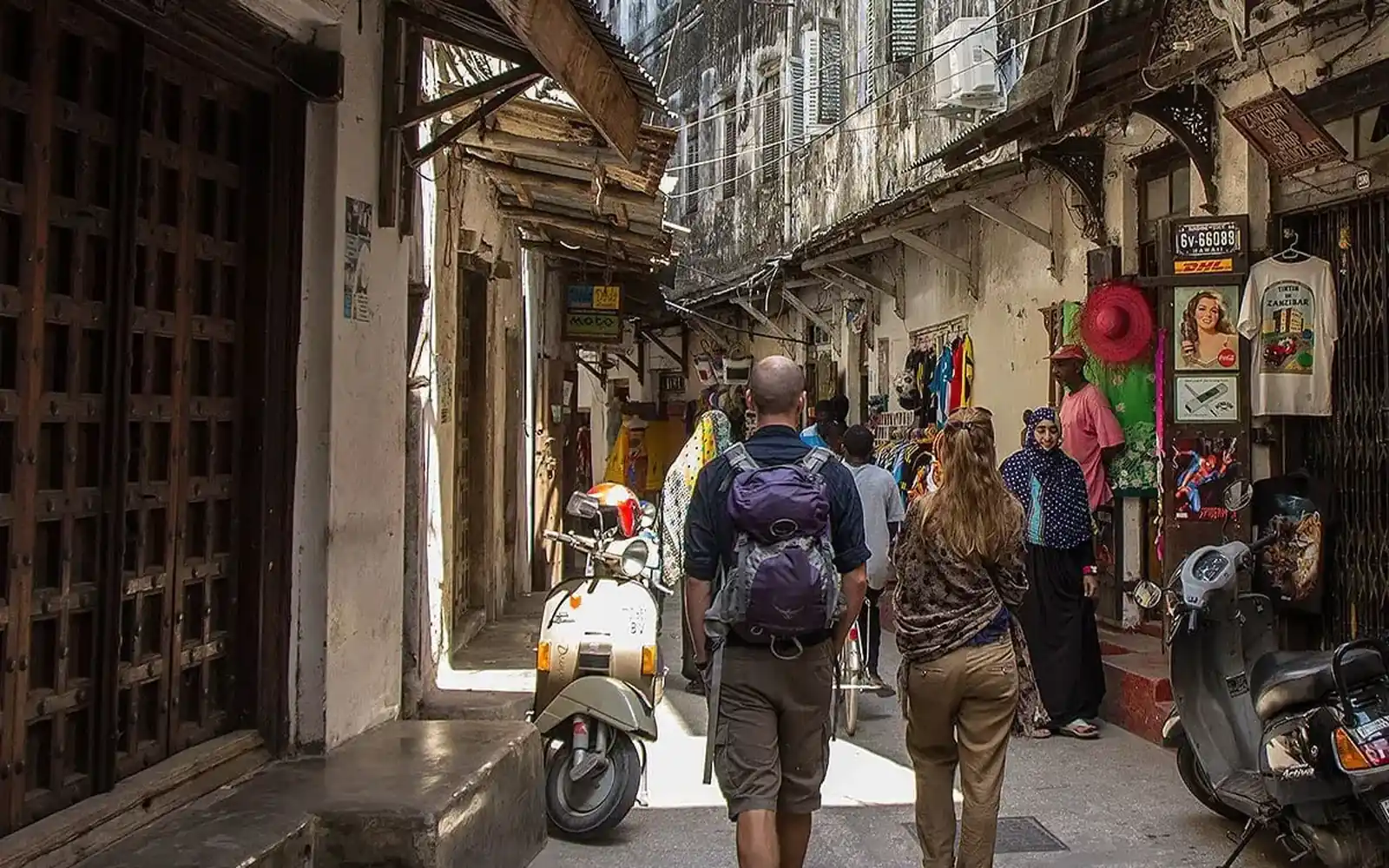
Stone Town is the reason Zanzibar is more than a beach. A UNESCO World Heritage site of coral-stone alleys, carved doors and a thousand years of Indian Ocean trade: packed into half a square kilometre you can walk end to end in twenty minutes.
- Guide
- Culture
- Reading time
- 17minutes
- In this guide
- 8sections
- 2 hours to two nights
- Routes, food, etiquette
- History in context
Written and maintained by the Safari Soles planning team in Arusha, Tanzania.
Stone Town is the historic core of Zanzibar City, the old Swahili trading capital of the Indian Ocean and a UNESCO World Heritage site since 2000.
- Half a day minimum; one overnight is the sweet spot; two nights suits history and photography travellers.
- Heritage site access is in flux under an ongoing restoration programme: check current access before building a day around any single museum.
- Dress modestly away from the seafront: shoulders and knees covered.
- The former slave-market site at Christ Church Cathedral is the most important stop in the town, and needs a full hour.
01 / 08
Choose your Stone Town visit
Start with how much time you are willing to give it, then let that decide what goes in. Each option below assumes you are not trying to do everything.
How much Stone Town do you need?
Stone Town rewards a night or two. Work out where it fits in your trip.
0 of 2 answered
Answer all 2 questions and your result appears here.
| Time | Best for | What fits |
|---|---|---|
| 2 hours | Layovers, a pre-flight gap, a beach day trip that ran late | Seafront skyline, the Old Fort from outside, one alley loop, one carved-door street |
| Half day | Most beach-based visitors | Guided walk, the former slave-market site, alleys and doors, plus the market or one museum |
| Full day | Culture-first travellers not staying over | Market early, the cathedral site, landmarks, lunch, architecture, sunset and Forodhani |
| One night | The sweet spot for most trips | Everything in the full day, plus a rooftop sunset and quiet streets from about 6:30am |
| Two nights | History, architecture and photography travellers | All of the above plus a spice tour or Prison Island as a half day |
2 hours
- Best for
- Layovers, a pre-flight gap, a beach day trip that ran late
- What fits
- Seafront skyline, the Old Fort from outside, one alley loop, one carved-door street
Half day
- Best for
- Most beach-based visitors
- What fits
- Guided walk, the former slave-market site, alleys and doors, plus the market or one museum
Full day
- Best for
- Culture-first travellers not staying over
- What fits
- Market early, the cathedral site, landmarks, lunch, architecture, sunset and Forodhani
One night
- Best for
- The sweet spot for most trips
- What fits
- Everything in the full day, plus a rooftop sunset and quiet streets from about 6:30am
Two nights
- Best for
- History, architecture and photography travellers
- What fits
- All of the above plus a spice tour or Prison Island as a half day
How to sequence whichever length you choose
- Early (06:30–09:00): Darajani market and empty alleys, in the coolest air and best light.
- Mid-morning: the cathedral and former slave-market site first, then museums, while you still have energy for them.
- Midday (12:00–15:00), lunch and shade. Pushing through the heat is the most common visitor mistake.
- Late afternoon: doors, alleys, the Old Fort walls and shopping in soft light.
- Evening: rooftop sunset over the harbour, then the Forodhani grills. Overnight adds the hour after 6:30am, when the streets belong to residents.
02 / 08
Stone Town sights worth understanding
Times are how long to allow, not opening hours. Zanzibar has an active heritage restoration programme running across the old town, so access at individual sites changes: check current access before visiting, and never build a whole day around one museum.
Christ Church Cathedral and the former slave market
The Anglican cathedral was begun in 1873, the year the public slave market closed, and deliberately built on the market site; the altar is traditionally said to stand where the whipping post stood. You see the underground holding chambers, the memorial sculpture of figures in a pit wearing original chains, and an interpretation centre.
It is confronting, and it is the most important thing in Stone Town. Allow at least an hour, go with a licensed guide, keep photography discreet, and do not take group photographs of yourselves here.
The former slave market in context Why Zanzibar was the centre of the East African trade, and how abolition actually unfolded.
Enslaved people were taken from the interior, in some cases from as far as the Great Lakes, carried to the coast alongside ivory caravans, sold here, and dispersed to plantations on Zanzibar and Pemba, to Arabia and across the Indian Ocean. The clove economy that built the merchant houses depended on that labour. Under British pressure, Sultan Barghash signed a treaty in 1873 closing the public market, but trafficking continued clandestinely and slavery was only fully abolished in the early twentieth century: a slow, contested process rather than a single date.
The waterfront landmarks
Old Fort (Ngome Kongwe): the oldest standing building in town, built by the Omanis in the late seventeenth century and since then a garrison, prison, railway terminus and tennis club. It has been reported closed for renovation, so check current access before visiting. Even when interior access is restricted, the fort remains an important landmark on the Forodhani waterfront and its massive coral-rag walls are worth the few minutes from outside.
House of Wonders (Beit al-Ajaib): Sultan Barghash's 1883 ceremonial palace, the first building on the island with electric light and a lift. Part of it collapsed in 2020 and it has been undergoing conservation, not operating as an ordinary museum, ever since. Check current restoration/access status before visiting and do not plan a day around going inside; from the seafront it is still the defining shape of the skyline.
Palace Museum (Beit el-Sahel): the former sultans' residence next door, covering the domestic and political life of the sultanate, including Princess Salme. Allow an hour if it is open; check current access before visiting.
Darajani Market and Forodhani Gardens
Darajani is where most of the city still buys its food: covered halls of produce and spices, a fish section running on the morning's landings, and outer streets folding into the bazaar. Go 7am to 10am, buy spices loose by weight rather than pre-packed gift sets, and remember this is a workplace: portraits need asking. Allow 45 minutes.
Forodhani Gardens is a seafront park by day and the town's food market after sunset. Order from a stall with a local queue, watch your food go on the grill, agree the price first, and skip pre-grilled seafood sitting under a lamp. Allow 60–90 minutes, arriving for sunset.
- Hamamni Persian Baths: Sultan Barghash's 1870s public baths; bare rooms, informal access, 20–30 minutes.
- St Joseph's Cathedral: 1890s twin spires, your orientation landmark above the alleys. 20 minutes.
- Freddie Mercury House: Farrokh Bulsara was born in Zanzibar in 1946; the Shangani museum is presented as the family home, though that is not firmly documented. Skippable.
- Jaws Corner and the alleys: the town's living room: a coffee vendor, benches and a permanent argument. Getting deliberately lost for an hour is the correct way to use the alleys; the old town is hemmed in by the sea and Creek Road, so you cannot go far wrong.
03 / 08
Should you stay overnight in Stone Town?
| Area or style | Best for | Trade-offs |
|---|---|---|
| Shangani / waterfront | First-time visitors, sunsets, easy walking to the seafront and Forodhani | The busiest, most visitor-facing corner; the priciest rooms in town |
| Deep old-town alleys | Atmosphere, boutique heritage houses, photographers | No vehicle access, luggage carried on foot, easy to get lost after dark, street noise |
| Boutique heritage hotels | Courtyards, carved doors, rooftop terraces, character | Stairs, no lifts, uneven floors, variable air conditioning |
| Modern hotels on the outskirts | Families, mobility needs, pools, lifts, car access | You lose the walk-out-the-door old-town experience and need a taxi each way |
Shangani / waterfront
- Best for
- First-time visitors, sunsets, easy walking to the seafront and Forodhani
- Trade-offs
- The busiest, most visitor-facing corner; the priciest rooms in town
Deep old-town alleys
- Best for
- Atmosphere, boutique heritage houses, photographers
- Trade-offs
- No vehicle access, luggage carried on foot, easy to get lost after dark, street noise
Boutique heritage hotels
- Best for
- Courtyards, carved doors, rooftop terraces, character
- Trade-offs
- Stairs, no lifts, uneven floors, variable air conditioning
Modern hotels on the outskirts
- Best for
- Families, mobility needs, pools, lifts, car access
- Trade-offs
- You lose the walk-out-the-door old-town experience and need a taxi each way
Best for
- You want the evening and early morning, not just the day
- History, food, architecture or photography is a real motive
- You are arriving late or leaving early from the airport
- You are comfortable walking and carrying a bag over uneven stone
Think twice if
- You want to step from your room onto a swimmable beach: there isn't one here
- Dense, noisy, humid cities are what you came on holiday to escape
- Anyone in the party has limited mobility, or you are pushing a stroller
- You need a big family room, a pool and a kids' club, or fewer than five nights and pure rest is the point
If Stone Town is not for you, visit for a half day from the coast instead. From the north-west (Kendwa, Nungwi) allow roughly 1 to 1.5 hours each way; from the east coast (Paje, Jambiani) roughly an hour; from Matemwe, about an hour to an hour and a quarter. A morning departure, a guided walk, lunch and back by mid-afternoon still leaves the beach evening intact, and it slots easily into ready-made Zanzibar itineraries if you would rather start from a set plan.
04 / 08
What to eat in Stone Town
Zanzibari cooking is a coastal African base (fish, coconut, cassava, rice) carrying two inheritances: Omani rice and meat cookery, and Gujarati spicing, with cloves, cinnamon and cardamom from the plantation economy on top.
After dark, pick stalls with a local queue and a working grill, avoid anything pre-cooked under a lamp, and confirm prices before ordering. Small local restaurants do pilau and curries cheaply; rooftops are for sunset and worth booking in high season, and alcohol is served in licensed venues only. We do not list named restaurants: ownership and standards change faster than any guide page can track.
| Dish | What it is | Where to find it |
|---|---|---|
| Urojo (Zanzibar mix) | Tangy turmeric-and-mango soup loaded with bhajia, potato and chutneys | Street stalls and Forodhani |
| Mishkaki | Marinated beef or chicken skewers grilled over charcoal | Evening street grills |
| Grilled octopus and kingfish | Simply grilled with lime, chilli and coconut | Forodhani and seafood restaurants; best cooked to order |
| Zanzibar pizza | Thin dough folded around egg, meat or vegetables and fried on a plate | Forodhani; savoury first, sweet version after |
Urojo (Zanzibar mix)
- What it is
- Tangy turmeric-and-mango soup loaded with bhajia, potato and chutneys
- Where to find it
- Street stalls and Forodhani
Mishkaki
- What it is
- Marinated beef or chicken skewers grilled over charcoal
- Where to find it
- Evening street grills
Grilled octopus and kingfish
- What it is
- Simply grilled with lime, chilli and coconut
- Where to find it
- Forodhani and seafood restaurants; best cooked to order
Zanzibar pizza
- What it is
- Thin dough folded around egg, meat or vegetables and fried on a plate
- Where to find it
- Forodhani; savoury first, sweet version after
Cooking classes, regional differences, Swahili food history and eating etiquette are covered properly in the Zanzibar food and culture guide.
05 / 08
Where Stone Town belongs in your trip
Almost every Stone Town regret is a sequencing problem. The town is 15–25 minutes from the airport and 1 to 1.5 hours from the main beach areas, so it costs very little at the start or end of a trip and a great deal in the middle: a mid-stay night burns two travel half-days to gain one evening. Our Zanzibar planning hub covers how this fits against beaches, timing and cost together.
After safari, it depends on arrival time and energy. Safari → Stone Town → beach works when you land late morning with something left; safari → beach → Stone Town works when you land late or the group is exhausted, and it is our default. Either way, keep the arrival day from the parks empty of sightseeing. See Zanzibar safari and beach.
After Kilimanjaro, recover on the beach first: hours of walking on uneven stone in humid heat is the opposite of what a body wants two days off the mountain. Two or three beach nights, then one Stone Town night at the end. See Kilimanjaro and Zanzibar.
Half-day pairings from Stone Town
-
Spice tour
Farms sit 30–45 minutes inland, so a half day out of town works cleanly.
Spice tour guide -
Prison Island
A 20–30 minute boat each way for the tortoises and the quarantine ruins. Go early.
Prison Island guide -
Jozani Forest
About an hour away, and easier to combine with an east-coast transfer.
Jozani guide
06 / 08
Getting around, dress, safety and access
Getting there and getting around
| From | How | What to know |
|---|---|---|
| Abeid Amani Karume International Airport | Taxi or pre-booked transfer, roughly 15–25 minutes | Arrange in advance; agree the fare before departure if taking a taxi |
| Dar es Salaam | Passenger ferry, around 2 hours on the fast service | The terminal is minutes from the old town; official counters only |
| Beach areas | Private transfer or taxi, roughly 1–1.5 hours | Traffic and road works move this significantly; leave slack before a flight |
| Within the old town | On foot | Vehicles cannot enter most alleys; the core is walkable in 20 minutes end to end |
Abeid Amani Karume International Airport
- How
- Taxi or pre-booked transfer, roughly 15–25 minutes
- What to know
- Arrange in advance; agree the fare before departure if taking a taxi
Dar es Salaam
- How
- Passenger ferry, around 2 hours on the fast service
- What to know
- The terminal is minutes from the old town; official counters only
Beach areas
- How
- Private transfer or taxi, roughly 1–1.5 hours
- What to know
- Traffic and road works move this significantly; leave slack before a flight
Within the old town
- How
- On foot
- What to know
- Vehicles cannot enter most alleys; the core is walkable in 20 minutes end to end
One guided half day at the start, then explore alone. A licensed guide is worth it for the history, the doors and the market, where it changes how you are received; atmosphere, photography and early mornings are better on your own. Book through your hotel or a locally based operator such as our Tanzania-based team rather than a street offer.
Dress and cultural etiquette
- Cover shoulders and knees away from the seafront. A t-shirt with light trousers, a long skirt or knee-length shorts is enough: nobody expects a headscarf on the street.
- Mosques: most are not open to non-Muslim visitors. Where entry is permitted, remove shoes, dress conservatively and women should cover their hair.
- Photography of people requires asking first, and a no is a no: particularly with women and at the market.
- Beachwear belongs on the beach. Walking the alleys in swimwear is the fastest way to be read as disrespectful. Keep public affection minimal, and drink only in licensed venues.
- Greet people. *Jambo*, *habari*, *asante*: a greeting before a question changes almost every interaction here.
- During Ramadan (it moves about eleven days earlier each year, so check your dates) many local cafés do not serve in daylight while hotels continue as normal. Eat discreetly, dress a little more conservatively and shift plans to the evening: after *iftar* the atmosphere is the best of the year.
Safety and accessibility
- Stone Town is generally safe to walk by day, including for solo travellers. The realistic risks are opportunistic theft and hassle, not violence.
- After dark, stick to lit main lanes and the seafront and arrange late transport through your hotel. Persistent hawkers respond to a firm, friendly *hapana asante* and continued walking.
- Do not swim off the town waterfront. This is a working harbour, not a beach.
- Streets are uneven coral stone with steps, high thresholds and open drainage channels, so wheelchairs and strollers are very difficult in the old town.
- Vehicles cannot reach most old-town hotels (expect 50–300 metres on foot with luggage) and historic hotels rarely have lifts. Tell your operator about mobility needs *before* the hotel is booked; a modern hotel on the outskirts is the workable alternative.
- Heat and humidity are the underestimated factor: plan the morning and late afternoon and stop entirely between about noon and 3pm.
Shopping and photography
- Buy spices by weight at Darajani, *kanga* and *kitenge* cloth, Tingatinga painting, woodwork or silver. Never buy shell, coral, turtle or any wildlife product.
- Best light is the first two hours after sunrise and the last two before sunset. Always ask before portraits, and be discreet at the slave-market memorial and inside places of worship.
07 / 08
Stone Town in seven moments
Enough history to make the walk legible, and no more. UNESCO inscribed the town in 2000 as an outstanding example of a Swahili coastal trading settlement.
- c. 8th–15th c.
Swahili Indian Ocean trade
Coastal settlements trade by monsoon sailing with Arabia, the Gulf and India. Islam spreads through commerce and Kiswahili takes shape as a Bantu language enriched by Arabic.
- 1499–1698
Portuguese, then Omani control
Two centuries of Portuguese dominance on the coast end when Omani forces expel them. Zanzibar comes under Omani authority and the Old Fort is built.
- 1832–1840
The sultanate moves to Zanzibar
Seyyid Said shifts the seat of the Omani sultanate from Muscat to Zanzibar. This is the decision that makes Stone Town a capital city.
- 19th c.
Cloves, ivory and the slave trade
Clove plantations make the islands a world producer and Zanzibar becomes the principal East African slave market. The 1873 treaty closes the public market; full abolition takes decades more.
- 1890–1963
British Protectorate
Zanzibar becomes a British protectorate with the sultanate retained as formal authority; much of the colonial public architecture dates from this era.
- 1964
Revolution, then union
A revolution overthrows the sultanate weeks after independence; thousands are killed and properties are subdivided. Months later Zanzibar unites with Tanganyika to form Tanzania.
- 2000
UNESCO World Heritage inscription
Stone Town is inscribed for its intact urban fabric and its role in Indian Ocean commerce and the slave trade, bringing conservation controls, and the tension between preservation, tourism and housing.
Why Stone Town looks and feels the way it does
Calling this an 'old Arab quarter' is lazy and wrong. What you walk through is the surviving urban core of Swahili coastal civilisation. An African culture that was a partner in the Indian Ocean trading world, not a colony of it. The monsoon made it work: north-east winds carried dhows down from Arabia and India from about December and the south-west monsoon carried them home from April, so crews stayed for months and family and credit networks stretched from Muscat and Kutch to this waterfront.
That is why the town feels layered rather than themed: Kiswahili is Bantu at its core with a large Arabic vocabulary on top, Islam has shaped daily life for over a thousand years, and Hindu temples, two cathedrals and Ismaili and Bohra community buildings sit within a few minutes' walk. It also explains the scaffolding: salt and rain attack coral rag relentlessly and conservation is permanent work here. The past is genuinely contested too, so be sceptical of any tour that delivers 1964 as one tidy narrative.
08 / 08
How to read Stone Town's architecture
Stone Town, on foot
Alley widths were set by shade, defence and foot traffic long before cars existed, which is why almost nothing motorised fits inside the old town.
Stone Town is built from what the island had. Coral rag: fossil reef limestone quarried nearby: is the structure, rendered with lime plaster burnt from the same coral. It is porous and quick to build with but hates standing water and salt, which is why an abandoned building here can fall apart within two decades. Floors and roofs sit on mangrove poles cut to a consistent length, which is why almost every old room is the same two-and-a-half to three metres wide.
The oldest domestic pattern is the Swahili and Omani courtyard house: inward-facing, rooms around an open court, with a baraza stone bench flanking the street door. Indian merchant buildings are immediately different: open shopfronts and ornate timber or cast-iron balconies over the lane: so walking from a residential lane into the bazaar you feel the change before anyone explains it. The narrow, crooked streets stay shaded and funnel sea breeze; along the waterfront the logic flips to monumental buildings meant to be read from a ship.
Understanding Zanzibar doors
Several hundred historic carved doors survive. A door advertised the owner's wealth, faith, trade and community: frame width and carving depth are the crudest and most reliable indicators, and a door far grander than the building behind it usually means the house was later subdivided.
Omani / Arab style
- Square, rectilinear frame with a straight lintel
- Carved inscriptions, often Quranic, along the lintel or centre post
- Chain, lotus, rosette and fish motifs in the frame
- Restrained geometry; generally the older surviving type
Indian / Gujarati style
- Semicircular arched top over the door leaves
- Heavy brass studs and, on some doors, projecting spikes
- Denser floral and vegetal carving, often painted
- Concentrated in the bazaar and merchant quarters: Shangani has the grandest
Common mistakes to avoid
The planning slips we see most often. Each one is easy to avoid once you know it.
- Treating Stone Town as a two-hour stop between the airport and the beach, then concluding there is nothing to it.
- Assuming the House of Wonders is an open museum. It has been a conservation site since the 2020 collapse.
- Skipping the former slave market because it is 'not a holiday thing'. It is the most important place in Zanzibar.
- Wearing beachwear in the alleys and reading the cool reception as unfriendliness.
- Putting a Stone Town night in the middle of a beach stay and losing two half-days to transfers.
- Walking the town between noon and three in the humidity, then giving up on it entirely.
- Dragging large hard suitcases into pedestrian alleys, or booking an alley hotel with a mobility need in the party.
- Eating pre-grilled seafood that has been sitting out at Forodhani.
The best way to fit Stone Town into a beach trip is one night at the start or the end: a first night if you land in the afternoon, a last night if you are arriving from a safari or a climb and need to recover first.
Site access is genuinely changeable, Zanzibar has an active heritage restoration programme running across the old town, so we confirm current status with the ground team before the day is built, and structure the walk so that a closure does not empty the itinerary.
Questions worth asking any operator
Copy these questions into your enquiry: to us or to any operator you are comparing. The answers tell you more about a Zanzibar trip than any brochure.
- Is the walking tour led by a licensed Zanzibari guide, and how large is the group?
- Does the tour include the Anglican Cathedral and the former slave-market site, with enough time for it?
- Which sites are currently open, and what happens to the itinerary if one is closed for restoration?
- How close can a vehicle get to our hotel, and is there help with luggage?
- Are entrance fees included, and do we need cash for any of them?
- How long is the transfer from our beach hotel, and is it a round trip on the same day?
- Do our dates fall in Ramadan or over a public holiday, and how does that change the day?
What Safari Soles puts in writing
Nothing important about your trip should be discovered at check-in. Each of these is put in writing for your itinerary before you pay a deposit.
-
Which beach area, and why that one for our dates?
Tide, wind and atmosphere vary hugely by coast; the reason should match how you want to spend your days.
-
What exactly is included in the board basis?
Half board, full board and all-inclusive mean different things island to island: drinks and excursions are often outside.
-
How are transfers and internal flights handled?
Baggage limits, drive times and connection buffers decide whether a safari-to-beach day is calm or stressful.
-
Which excursions are booked, and at what price?
Pre-booked trips at fixed prices avoid beach-side selling and surprise costs mid-holiday.
-
What is the payment, change and cancellation policy?
Island hotels have their own terms; you should see them in writing before you pay a deposit.
How we run a Zanzibar trip
Safari Soles is a Tanzania-based team. This is what we do for every traveller who books an island stay with us, in plain language.
-
One planner, start to finish
The person who plans your route is the person who answers on the day you travel. No handover to an unnamed inbox.
-
Itemised quotes
Accommodation, transfers, flights, excursions and fees are listed separately so you can see exactly what you are paying for.
-
Safari and beach as one trip
We plan the parks, the internal flight and the island days together, which is where most Zanzibar itineraries go wrong.
-
Honest seasonal advice
If your dates fall in the long rains or a tide window that will not suit you, we say so and suggest an alternative.
Planned by people who live the route
This hub exists because the same Zanzibar questions come up on every safari enquiry we answer.
- Locally based in Tanzania
- Safari and island specialists
- Licensed and insured operator
- Fast, direct answers
- Read Safari Soles reviews on TripAdvisor
- Read Safari Soles reviews on SafariBookings
- Read Safari Soles reviews on Google
Where these facts come from (4)
- UNESCO: Stone Town of Zanzibar World Heritage listing describing the Swahili coastal culture that shapes Zanzibari food, language and daily life.
- UNESCO Urban Heritage Atlas: Stone Town Mapping of Stone Town's historic urban structure: Swahili courtyard houses, Omani and Indian building types, shopfronts, balconies, carved doors, coral-rag construction, barazas and the narrow street pattern.
- Freddie Mercury Museum, Zanzibar Official museum site for the Mercury House exhibition in Shangani: location, opening hours, visitor information and what the exhibition covers.
- Zanzibar Commission for Tourism Official island tourism body: licensed operators, entry rules and visitor information.
Related Safari Soles guides
Continue with the guides travellers usually read next.
- Zanzibar Spice Tour What a spice farm visit actually involves, when to book it and how it pairs with a Stone Town day. Culture
Read the guide
 Prison Island Zanzibar The giant tortoise sanctuary, snorkelling off the island and how the boat trip fits into a Stone Town day. Culture
Read the guide
- Best Beaches in Zanzibar A side-by-side look at the main coasts: tide behaviour, swimming, atmosphere and who each beach actually suits. Beaches
Read the guide
Frequently Asked Questions
-
For almost everyone, yes. It is a UNESCO World Heritage site and the one place that explains the island's Swahili, Omani, Indian and European history. The exception is a short beach-only holiday where a half-day trip would cost you a meaningful share of your time.
Build Stone Town into your island days
We place it where it costs you the least travel (usually your first or last night) with a licensed local guide, a transfer that lines up with your flights, and current site access checked before the day is planned.