


Kenya Honeymoon Safari
A honeymoon safari is not a normal safari with rose petals added. The decisions that matter are structural: how many vehicles share your sightings, how far you travel between places, and where the trip ends.
- Priority
- Privacy over park count
- Where to stay
- Conservancies over busy reserve areas
- Getting around
- Fly between regions where possible
- Trip ending
- Finish at the beach, not in Nairobi
Written and maintained by the Safari Soles planning team in Arusha, Tanzania.
The strongest Kenya honeymoons trade breadth for privacy.
- Privacy, not park count, is what makes a honeymoon safari feel different.
- Conservancies and Laikipia beat busy reserve areas for couples, because vehicle numbers are capped.
- Fly between regions to protect the days you have.
- Eight nights works; ten to twelve is the comfortable range; fourteen allows two countries or three regions.
- Small camps in the bush and a larger property at the beach is usually the right split.
- The green months often make a better honeymoon than peak migration season.
01 / 07
Choose the shape of the trip first
Honeymoon planning goes wrong when it starts with camps. Start with the shape: how much of the trip is wildlife, how much is beach, and whether you want one country or two. Everything else follows.
Four honeymoon patterns
Safari and beach
Wildlife-first
Luxury fly-in
- Small camps, private vehicles, short flights
- Maximum privacy per night spent
- Higher cost, minimal wasted time
- See the luxury safari guide
Kenya and Tanzania
- Two ecosystems in one trip
- 12–14 nights minimum to do it properly
- Border logistics to plan around
- See Kenya and Tanzania safari
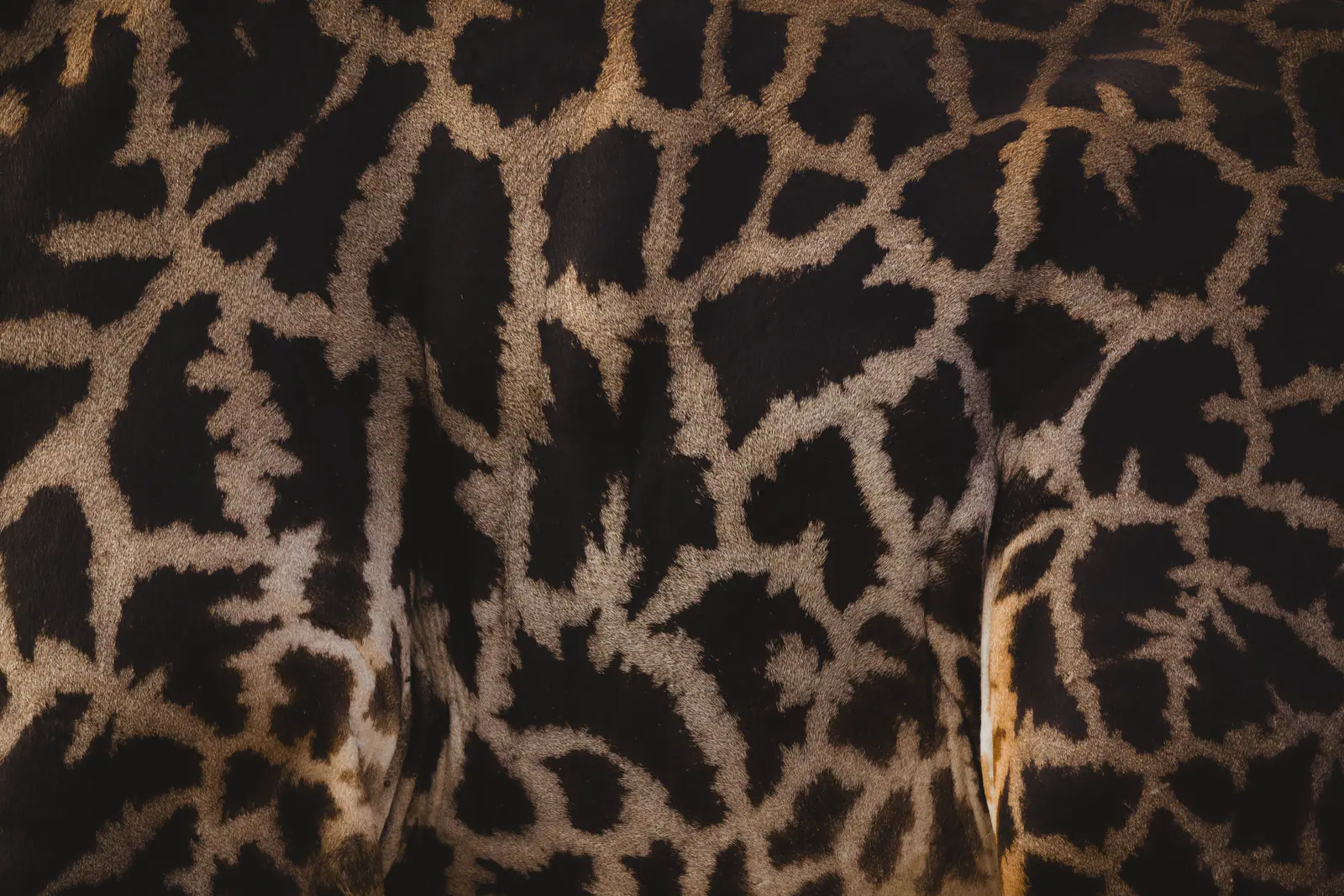
Close-up of a giraffe's coat in deep shadow, a pale web of lines around dark patches.
02 / 07
Where to stay, and why conservancies dominate this list
The single biggest determinant of how a honeymoon safari feels is how many other vehicles are at your sightings. In the busiest sections of the Maasai Mara National Reserve at peak season, a good leopard sighting can gather a considerable number of vehicles. In a conservancy, numbers are capped, and the difference between watching a leopard with fifteen vehicles and watching one with two is not marginal.
That is why conservancies dominate honeymoon recommendations in Kenya. Mara conservancies give you the same ecosystem with far more space, flexible timing, and often night drives and walking where properties permit. Laikipia goes further still: very low bed density, activities out of the vehicle, and a large number of small owner-run camps and exclusive-use houses.
Amboseli earns a place for a different reason: two nights beneath Kilimanjaro is a genuinely distinctive opening to a trip, and its accessibility from Nairobi makes it easy to slot in before the longer stay. What it does not offer is the seclusion of a conservancy, so use it as the short first act rather than the centrepiece.
The regions that suit honeymoons
-
Maasai Mara conservancies
The best wildlife in Kenya without the vehicle crowding of the reserve. Night drives and walking at many properties, subject to conservancy rules.
-
Laikipia
The privacy choice. Small camps, exclusive-use houses, riding and walking where offered, and outstanding rhino conservation.
-
Amboseli
Elephants and Kilimanjaro. A strong short opening act rather than the main stay. See Amboseli.
-
Samburu
Dramatic dry-country landscapes, riverside camps and a species mix you will not see elsewhere. Quiet and distinctive.
-
Diani
Kenya's south coast. Same country, no extra border, straightforward from a southern circuit.
-
Zanzibar
A stronger contrast and a genuine change of culture, at the cost of a second country's entry requirements.
03 / 07
Trip patterns at 8, 10, 12 and 14 nights
These are structures rather than fixed itineraries, but the proportions hold. Note how the number of regions rises slowly. The extra nights mostly go into staying longer rather than seeing more.
Honeymoon structures by length
-
8 nights
- Less suited to
- No room for a second safari region. Tight if flights are awkward
- Sample route
- Mara conservancy (4) → Diani (4)
- Pace
- One internal flight
- Trade-off
- The most efficient honeymoon shape Kenya offers.
- One safari region done properly
- Four nights at the coast
- Minimal internal travel
-
10 nights
- Less suited to
- Two internal flights. Higher cost
- Sample route
- Amboseli (2) → Mara conservancy (4) → Diani (4)
- Pace
- Fly between all legs
- Trade-off
- Variety without rushing: the most commonly chosen length.
- Two safari regions
- Beach ending intact
- Time to slow down
-
12 nights
- Less suited to
- Cross-border planning if Zanzibar is included
- Sample route
- Laikipia (3) → Mara conservancy (4) → Zanzibar (5)
- Pace
- Three flights, all short
- Trade-off
- The strongest all-round Kenya honeymoon at a realistic length.
- Genuine depth in the bush
- Island ending
- Room for activities beyond drives
-
14 nights
- Less suited to
- Highest cost. More logistics to manage
- Sample route
- Samburu (3) → Laikipia (3) → Mara (4) → Zanzibar (4)
- Pace
- Fly-in throughout
- Trade-off
- Everything Kenya does well, with room to breathe.
- Three regions or two countries
- Long, unhurried beach finish
- Time for a rest day mid-trip
04 / 07
Privacy versus resort scale
There is a real fork here and it is worth naming. A small camp of six or eight tents gives you a guide who learns your names by the second morning, meal times that flex around your drives, and the sense of having the place largely to yourselves. What it does not give you is a spa, several restaurants or a large pool.
A larger lodge or resort reverses that. More facilities, more choice, more polish, and more people, more fixed schedules and more shared vehicles unless you pay for a private one.
For most honeymoons the answer is small in the bush and larger at the beach. Intimacy is worth more when you are watching wildlife; facilities are worth more when you are spending four days doing very little. Splitting the decision that way usually produces a better trip than applying one philosophy throughout.
Small camp or larger property?
05 / 07
Seasonality, and how it affects a honeymoon specifically
The migration months of roughly July to October bring the best-known wildlife spectacle and the highest prices and vehicle numbers. For honeymooners that trade is not always worth it: the conservancies mitigate the crowding, but rates are at their annual peak and the best small camps book a year ahead.
The green months are frequently the better honeymoon. Rates soften considerably, vehicle numbers drop, landscapes are dramatic and photography is often better. Wildlife disperses somewhat and rain comes in short heavy bursts rather than all-day drizzle, which for a trip built around privacy and rest is a fair exchange.
The coast follows a different pattern from the bush, so check both halves of your trip rather than one. The seasonal detail is in best time to visit Kenya.
Book earlier than feels necessary
Small camps have very few rooms, and honeymoon travellers tend to want the same ones. For peak-season dates, twelve months ahead is not unusual; for green-season dates, six is generally comfortable. If a specific camp matters to you, that date drives the rest of the planning.
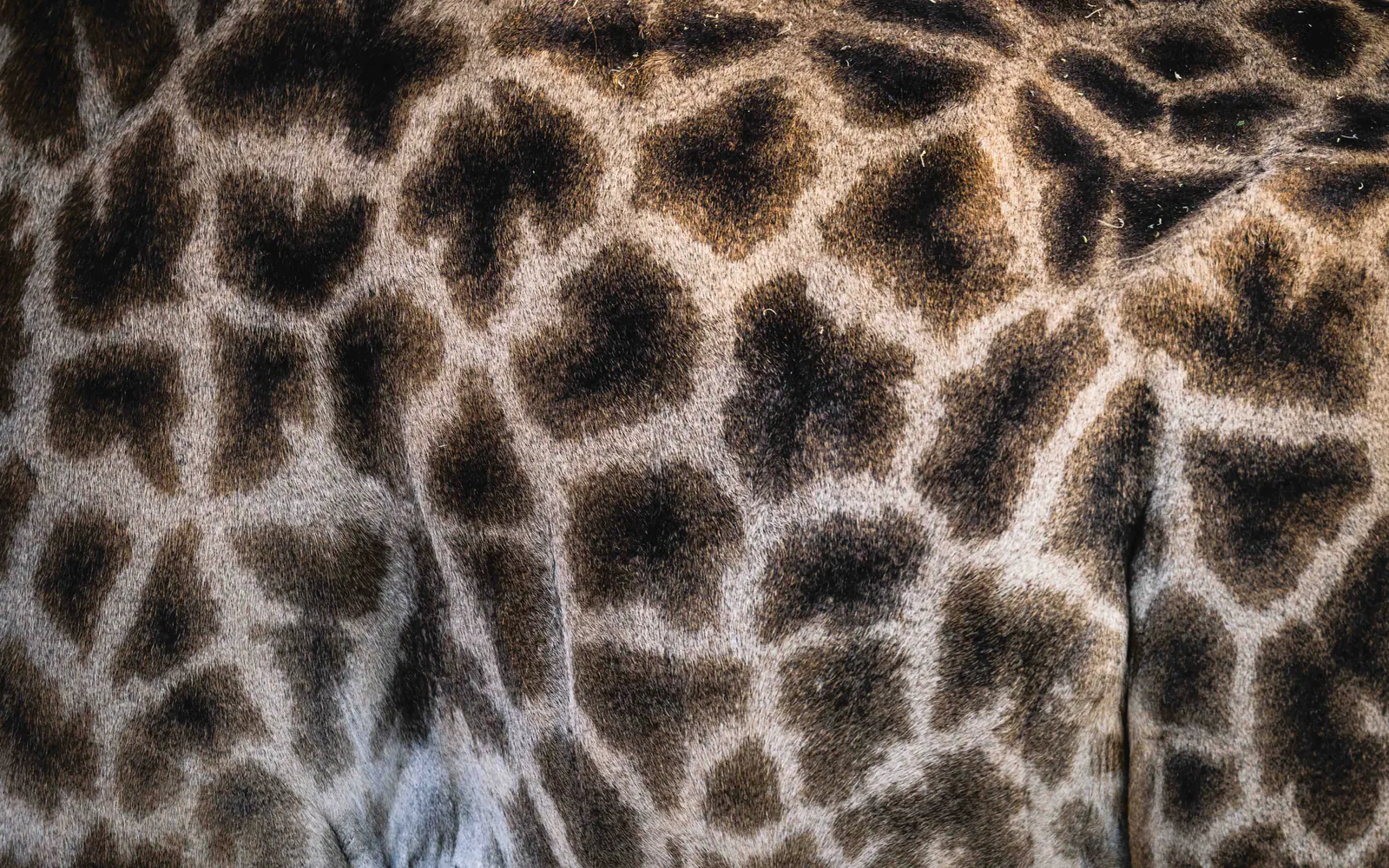
Close-up of a giraffe's coat, with dark patches divided by pale lines. No two giraffes carry quite the same pattern.
06 / 07
The practical details worth getting right
Ask for a private vehicle in the bush. On a honeymoon it is the difference between watching a sighting at your own pace and watching it at someone else's. Many small camps include it; some charge a supplement, and it is usually worth paying.
Tell camps you are on honeymoon when booking rather than on arrival. Most will do something thoughtful, and the ones that arrange private bush dinners or sundowner setups need notice to do it well.
Finally, protect the end of the trip. The commonest structural error is a beach stay so short that you spend it recovering from the travel. Four nights is the minimum for the coast to function as rest rather than as another leg. See Kenya safari and beach for choosing between the options.
07 / 07
Where to take this next
Most honeymoon questions are really property and pace questions: read luxury Kenya safari for the top tier and how to plan a Kenya safari for the order to decide in.
For the beach half, compare Kenya safari and Zanzibar with Kenya safari and Diani. Private-feeling game viewing is easiest on conservancy land. See Laikipia. Wider context: the Kenya safari guide and the Kenya safari guides library.
Planned by people who live the route
This library exists because the same Kenya questions arrive with every safari enquiry we answer.
- Locally based in Tanzania
- Kenya and Tanzania route specialists
- Licensed and insured operator
- Fast, direct answers
- Read Safari Soles reviews on TripAdvisor
- Read Safari Soles reviews on SafariBookings
- Read Safari Soles reviews on Google
Where these facts come from (1)
- Conservancies in Kenya: the community and private conservancy model Kenya Wildlife Conservancies Association · Conservation body · checked 2026-09-14
Related Safari Soles guides
Continue with the guides travellers usually read next.
 Kenya Luxury Safari Fly-in routing, private conservancies, small high-end camps and the privacy that separates a premium trip from an expensive one. Traveler Types
Read the guide
 Kenya Safari + Zanzibar A Kenya safari finished on Zanzibar: how the regional flights work, how many nights the island needs and when it beats staying inside Kenya. Safari Combinations
Read the guide
 Reserve vs Conservancy How national reserves and private or community conservancies differ on vehicle numbers, permitted activities, camp style and cost, and why rules vary by conservancy. Comparisons
Read the guide
Frequently Asked Questions
-
Eight nights is the workable minimum with one safari region and a beach stay. Ten to twelve is the sweet spot, and fourteen allows three regions or a second country.
Build this into a real Kenya route
Send us the dates, the travellers and the wildlife you care about most, and we will turn this guide into an itinerary that actually works on the ground.