


Kenya and Tanzania Safari
This is not a comparison page. If you have already decided to do both countries, the questions that remain are route order, how you cross, and how many nights it honestly takes.
- Recommended stay
- 12–14 nights is the comfortable range
- Natural link
- Mara to Serengeti
- Entry requirements
- Two separate sets
- Border crossing
- Fly where possible
Written and maintained by the Safari Soles planning team in Arusha, Tanzania.
Combining Kenya and Tanzania works best at twelve nights or more, though nine is possible if you fly every leg and accept two regions per country at most.
- Twelve to fourteen nights is the comfortable range; nine is the honest minimum and requires flying everything.
- The Mara to Serengeti flight is the natural spine of the trip, with immigration handled at the airstrip.
- Kenya contributes variety and short distances; Tanzania contributes scale and the Ngorongoro Crater.
- Fix the cross-border flight first, then build camp nights around it.
- Each country's entry requirements are separate and must be arranged individually before travel.
- Start where you land, and never cross a border on the day of a long-haul departure.
01 / 07
What each country contributes
If you are already committed to both, it helps to be clear about why, because it should shape which regions you choose in each country rather than duplicating the same experience twice.
Kenya contributes variety within short distances. The Maasai Mara for predator density, Amboseli for elephants and Kilimanjaro, Laikipia and the Mara conservancies for privacy and walking, and a coast that is genuinely easy to reach. Distances between regions are comparatively short, and the conservancy model gives access to activities national parks do not permit.
Tanzania contributes scale. The Serengeti is vast, the Ngorongoro Crater is unlike anything in Kenya, and the southern and western circuits offer wilderness on a different order. The trade is travel time: Tanzanian distances are longer and the northern circuit takes more days to cover properly.
The strongest combined trips exploit that difference rather than fighting it: Kenya for variety and pace, Tanzania for scale and the crater. The full head-to-head, if you have not yet decided, is in Kenya versus Tanzania.
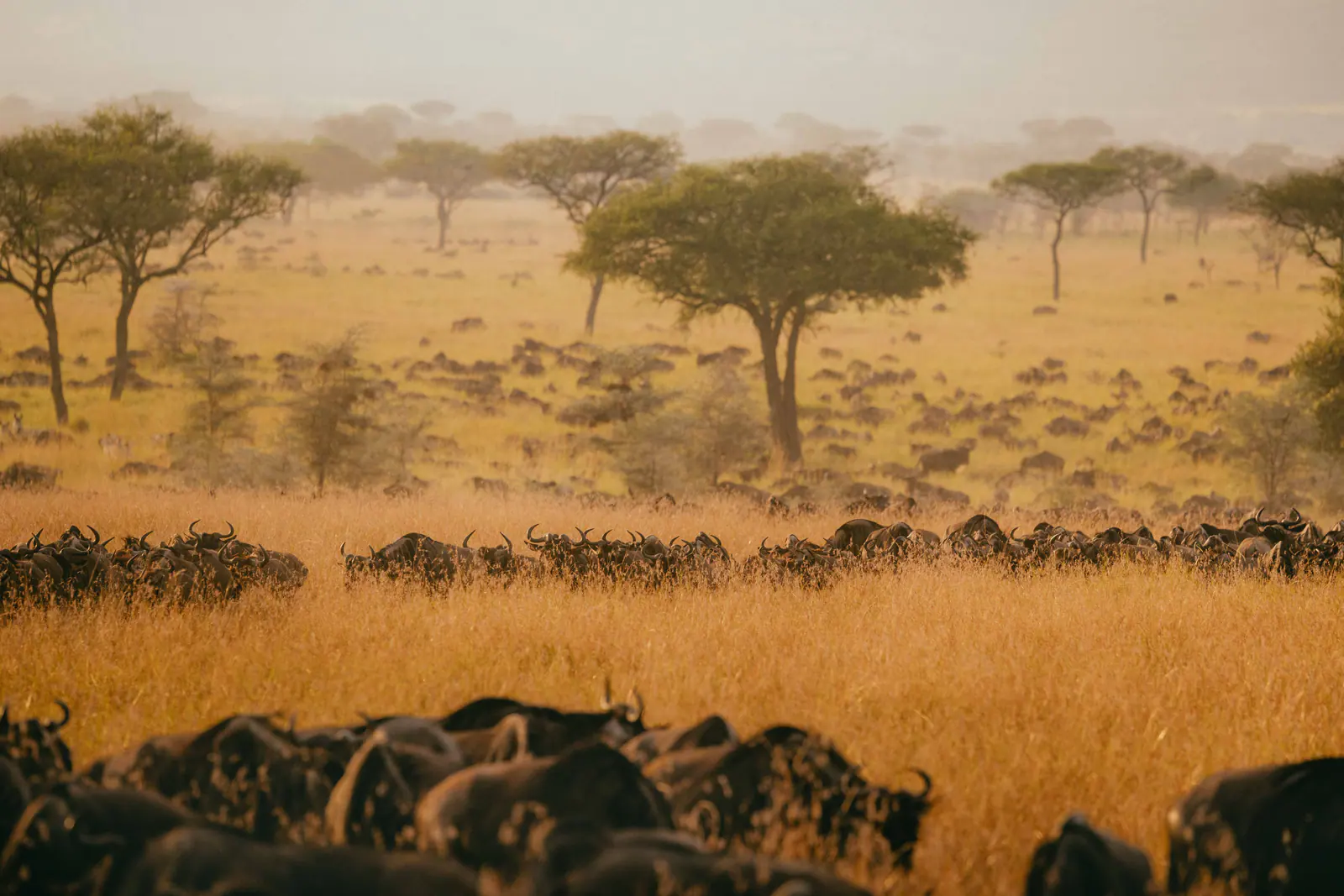
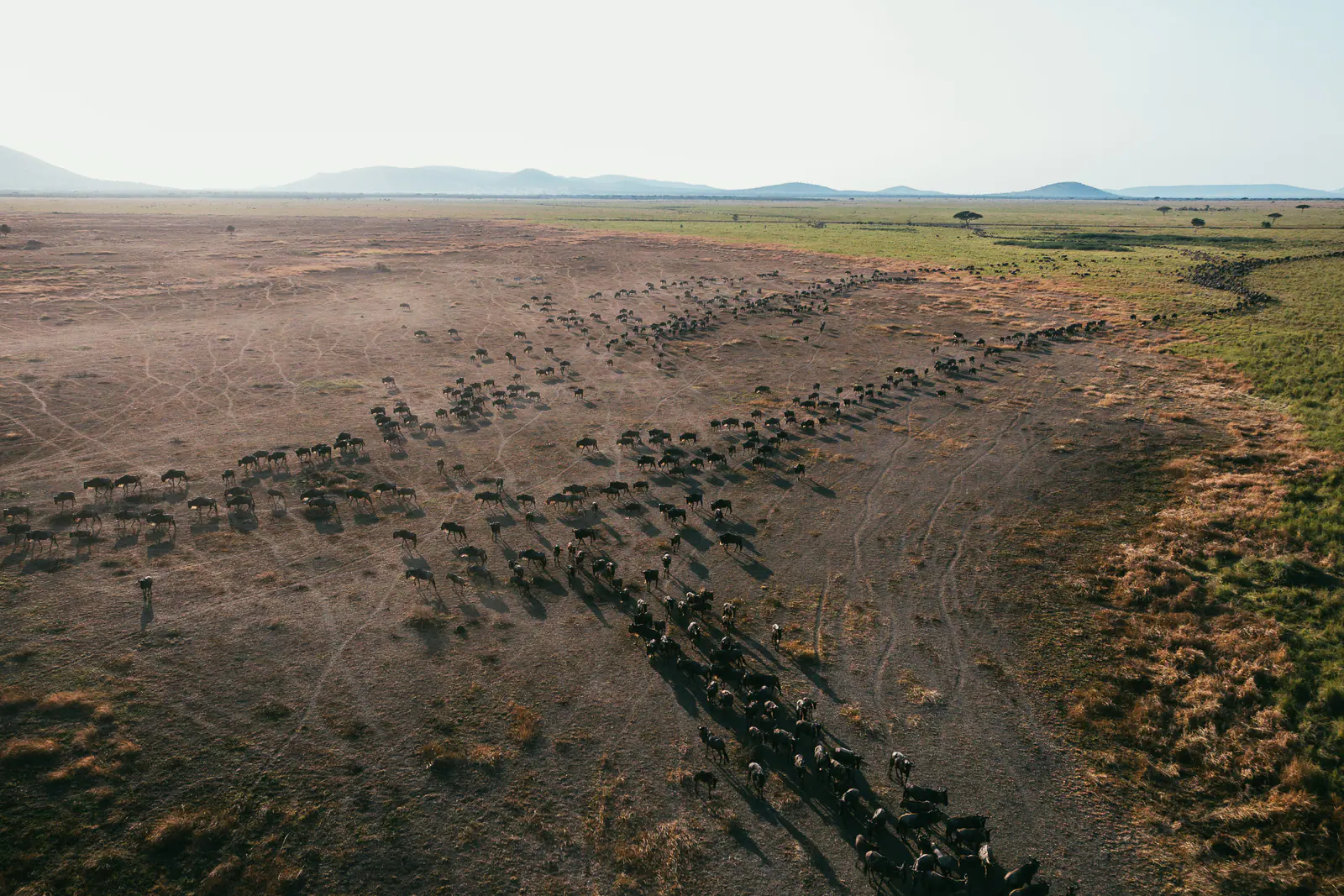
A wide plain of acacias and tall grass, with wildebeest massed along the bottom of the frame and more streaming across the distance.
02 / 07
The Mara–Serengeti link, and why it is the natural spine
The Maasai Mara and the Serengeti are a single ecosystem separated by an international boundary. The migration moves across it, and the habitat on either side is continuous. That makes the crossing between them the most logical structural element in any combined trip.
In practice the crossing is almost always flown. Light aircraft operate between Mara airstrips and Serengeti airstrips with immigration handled on arrival, which turns what would be a long and awkward road day into a short flight. Road crossings exist and are used, but they consume most of a day and add a transfer at each end.
The one thing to plan carefully is that this is an international movement, not a domestic transfer. Entry requirements for the receiving country must already be in place, and schedules can be limited, so the crossing day tends to dictate the shape of the rest of the itinerary. Note also that the migration does not simply live in one country, where it is depends on the month, which affects how you order the two halves.
Confirm the crossing before you book the camps
Cross-border light aircraft schedules are less frequent than domestic ones, and the available crossing day often determines how many nights you spend on each side. Fix the crossing first, then build the camp nights around it, rather than the other way round.
03 / 07
Three route patterns that work
These are the structures that survive contact with real schedules. The shorter one requires flying everything; the longer ones allow some breathing room.
Combined routes by length
-
9 nights
- Less suited to
- No beach extension. No room for schedule disruption. Amboseli or Laikipia will have to go
- Sample route
- Maasai Mara (4) → Serengeti (3) → Ngorongoro (2)
- Pace
- Fast; one cross-border flight
- Trade-off
- Doable, but every day is committed. The minimum honest length.
- Two regions per country at most
- Fly every leg
- First visit to both
-
12 nights
- Less suited to
- Still tight if you also want the coast
- Sample route
- Amboseli (2) → Maasai Mara (4) → Serengeti (4) → Ngorongoro (2)
- Pace
- Comfortable with flights on the long legs
- Trade-off
- The best-balanced combined itinerary at a realistic length.
- Three regions across the two countries
- A buffer day
- Ngorongoro included properly
-
14 nights
- Less suited to
- Highest cost. Most logistics to coordinate
- Sample route
- Maasai Mara (4) → Serengeti (4) → Ngorongoro (2) → [Zanzibar](/kenya-safari-and-zanzibar) (4)
- Pace
- Flown throughout, ending at the coast
- Trade-off
- The classic two-country trip. Zanzibar is straightforward from Tanzania's northern circuit.
- Both countries plus a beach finish
- Slower pace throughout
- Room for a rest day
How a twelve-night route actually moves
-
Nairobi → Amboseli
Approximate flight time: 45 min – 1 hr
Trade-off: Or roughly four to six hours by road, depending on conditions.
-
Amboseli
Overnight: 2 nights
Trade-off: Elephants and, cloud permitting, Kilimanjaro at dawn.
-
Amboseli → Maasai Mara
Approximate flight time: 1 hr 30 – 2 hrs
Trade-off: Usually routed via Nairobi. Driving this leg costs the better part of a day.
-
Maasai Mara
Overnight: 4 nights
Trade-off: The wildlife core of the Kenyan half.
-
Maasai Mara → Serengeti
Approximate flight time: 1–2 hrs
Trade-off: The cross-border leg. Immigration formalities at the airstrip; entry requirements arranged in advance.
-
Serengeti
Overnight: 4 nights
Trade-off: Scale and space; the area you stay in should follow the season.
-
Serengeti → Ngorongoro
Approximate road time: 3–5 hrs
Trade-off: Approximate and highly condition-dependent. Flying to Lake Manyara and driving on is an alternative.
-
Ngorongoro → Arusha or Kilimanjaro
Approximate road time: 3–4 hrs
Trade-off: For the international departure or an onward flight to Zanzibar.
Journey times are approximate and vary with road conditions, weather, schedules and where exactly you are staying. Confirm current timings when your itinerary is finalised.
04 / 07
Which country first?
There is no universal answer, but there are patterns. Starting in Kenya suits most travellers arriving through Nairobi, which has the widest range of international connections, and it puts the shorter Kenyan legs first while energy is high. It also means the trip finishes in Tanzania, which is convenient if you want Zanzibar at the end.
Starting in Tanzania makes sense if you are arriving into Kilimanjaro International Airport, or if the migration's expected position that month favours the Serengeti early and the Mara later. Since the herds move across the border seasonally, the month can genuinely reverse the ideal order.
One practical note either way: build the international departure into the last country, not back across the border. A final cross-border hop on the day of a long-haul flight adds risk for no benefit.
Deciding the order
Kenya first
- Arriving via Nairobi
- Wider international connections
- Ending in Tanzania for Zanzibar
- Migration expected in the Mara later in your window
Tanzania first
- Arriving via Kilimanjaro
- Migration expected in the Serengeti early in your window
- Ending in Kenya with a Diani or Nairobi departure
- Longer Tanzanian legs done while fresh
05 / 07
Two countries, two sets of requirements
This is the part most commonly underestimated. Kenya and Tanzania operate separate immigration systems, and entering one does not satisfy the other. Each country's authorisation must be arranged individually, according to that country's official process, before you travel.
For Kenya, requirements and any exemptions are set out by the Kenyan immigration authorities and the official Kenya eTA service: the detail, including current East African Partner State arrangements, is in Kenya entry requirements. For Tanzania, check the Tanzanian immigration authority's own guidance; do not assume the Kenyan process covers it.
Passport validity, blank pages, onward travel evidence and any health requirements should be checked against both countries' official guidance rather than third-party summaries. Requirements change, so verify close to travel as well as at the point of booking.
Verify both, close to departure
Entry rules, fees and exemptions for both countries are set by their governments and can change at short notice. Treat any summary, including this one, as orientation, and confirm the current position on each country's official immigration site before you travel.

A male lion lies low in tall golden grass, his mane just visible above the stalks. Grass this high hides a lion until you are close.
06 / 07
Cost, season and the honest trade-offs
A combined trip costs more than the sum of two shorter ones would suggest, because the cross-border flights, the extra entry requirements and the additional park fee regimes all stack. The single largest saving available is fewer regions with more nights in each, which cuts flights and transfers at the same time.
Seasonally, the July-to-October window is when the migration is most associated with the Mara and the northern Serengeti, which is also when both countries are at peak rates. The green months bring lower prices, fewer vehicles and dramatic landscapes, with wildlife more dispersed. Neither country has a bad season; they have different ones.
The honest caution is pace. Two countries in nine nights produces a good trip and a tiring one. If the choice is between adding a second country and adding four nights to a single-country trip, the second option is frequently the better holiday. The case for each is in how many days and Kenya safari cost.
07 / 07
Where to take this next
If you have not yet decided that both countries are worth it, read compare Kenya and Tanzania first, then Maasai Mara versus Serengeti for the two parks this trip usually joins.
Herd timing across the border sits in the Great Migration in Kenya guide, and the Tanzanian half is covered in the Serengeti safari guide and our Tanzania safari guides. Kenya-side circuits sit on the Kenya safari guide. Trip length: how many days. Full library: the Kenya safari guides library.
Planned by people who live the route
This library exists because the same Kenya questions arrive with every safari enquiry we answer.
- Locally based in Tanzania
- Kenya and Tanzania route specialists
- Licensed and insured operator
- Fast, direct answers
- Read Safari Soles reviews on TripAdvisor
- Read Safari Soles reviews on SafariBookings
- Read Safari Soles reviews on Google
Where these facts come from (4)
- Kenya Electronic Travel Authorisation: official portal Directorate of Immigration Services, Republic of Kenya · Immigration · checked 2026-09-14
- Visa information for visitors to Tanzania Immigration Services Department, Tanzania · Immigration · checked 2026-09-14
- Serengeti National Park: park information Tanzania National Parks (TANAPA) · Park authority · checked 2026-09-14
- Tourism, Wildlife and Culture: Maasai Mara National Reserve oversight Narok County Government · Reserve authority · checked 2026-09-14
Related Safari Soles guides
Continue with the guides travellers usually read next.
 Kenya vs Tanzania Safari A country-level comparison across wildlife areas, trip length, routing, cost structure and beach pairings, without declaring an overall winner. Comparisons
Read the guide
 Maasai Mara vs Serengeti Two halves of one migration ecosystem: scale, vehicle density, seasonal movement, access and what each side does better at different times of year. Comparisons
Read the guide
 Kenya Entry Requirements How the official electronic travel authorisation works, passport validity, health documentation and what to prepare before you fly. Planning
Read the guide
Frequently Asked Questions
-
Twelve to fourteen nights is comfortable. Nine is possible if you fly every leg and limit yourself to two regions per country, but there is no slack in it.
Build this into a real Kenya route
Send us the dates, the travellers and the wildlife you care about most, and we will turn this guide into an itinerary that actually works on the ground.