


Nyungwe National Park: The Complete Rainforest Guide
What Nyungwe is, why UNESCO inscribed it as a natural World Heritage property in 2023, and how to plan the canopy walk, trails, birding and primates into a Rwanda circuit.
- Area
- 101,900 ha
- Status
- UNESCO World Heritage (2023)
- Primates
- 13 species
- Main sectors
- Uwinka / Gisakura
Written and maintained by the Safari Soles planning team in Arusha, Tanzania.
Nyungwe is Rwanda's largest montane rainforest, inscribed as a natural UNESCO World Heritage property in September 2023.
- Status: UNESCO natural World Heritage since 2023
- Signature structure: Canopy walkway over a forest ravine
- Best paired with: Lake Kivu or a full north–south circuit
- Typical stay: 2–3 nights
01 / 11
What Nyungwe National Park is
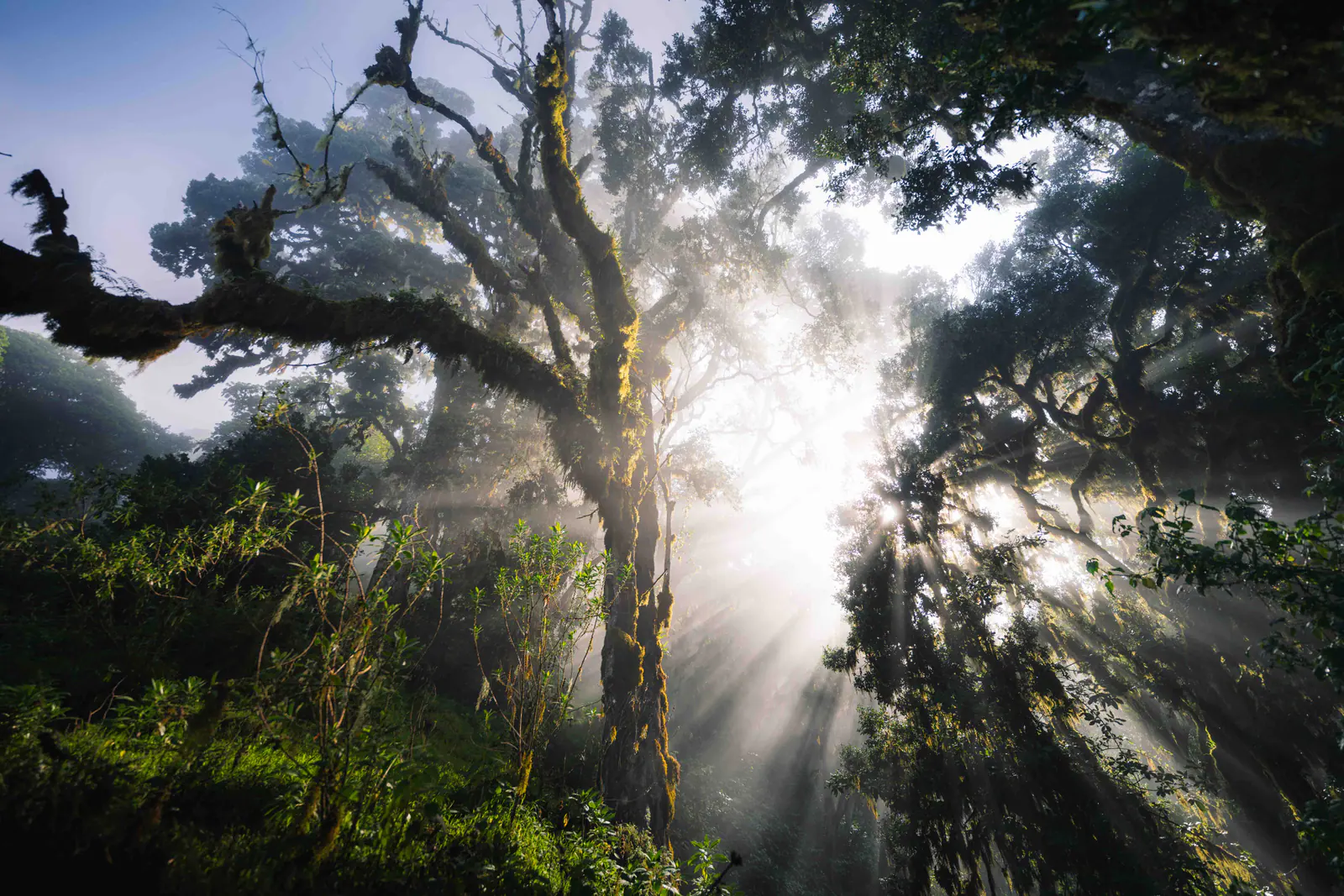
Sunbeams fan out through a tall, moss-covered tree in misty forest.
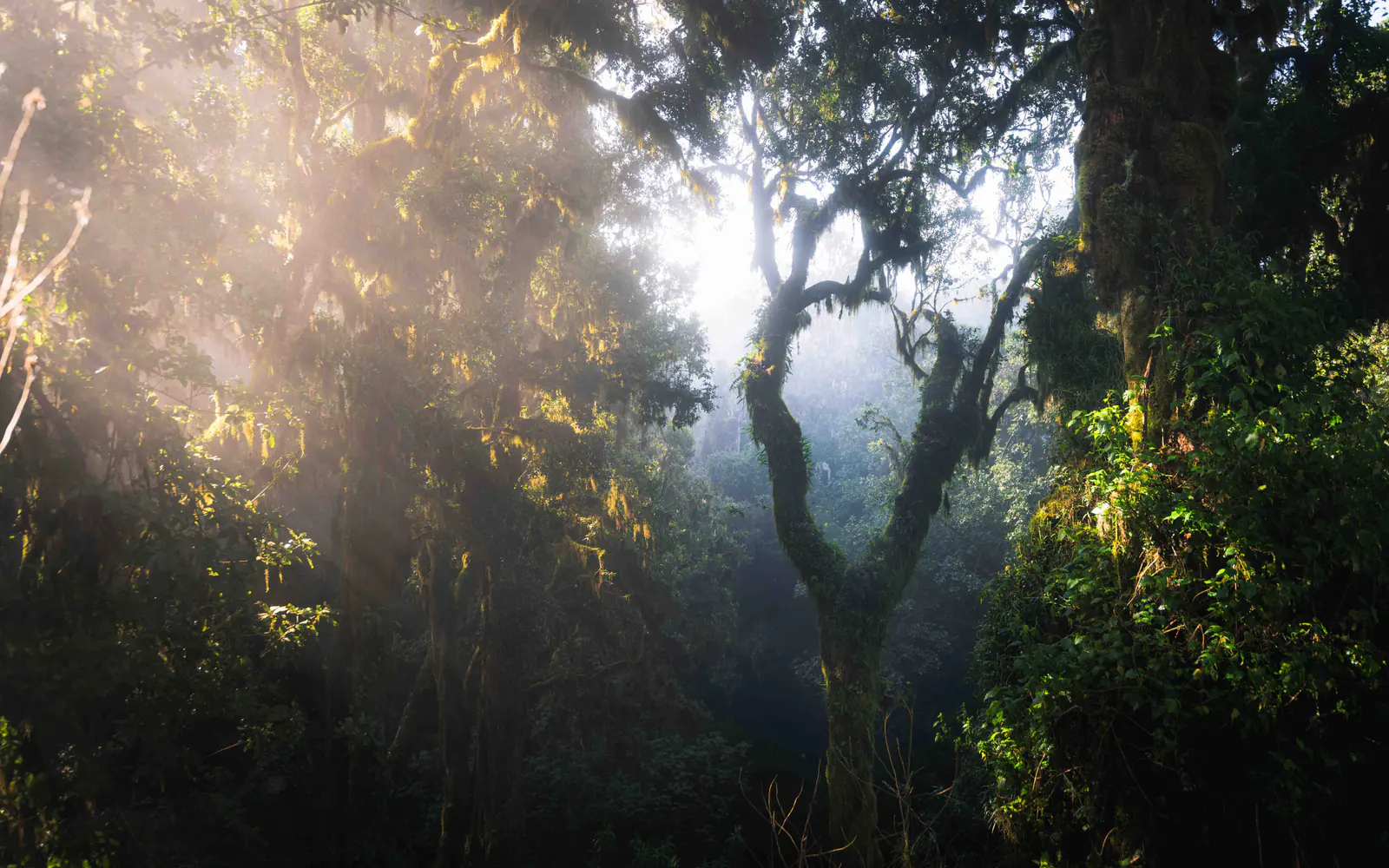
Nyungwe National Park is a large block of montane rainforest in southwestern Rwanda, part of the Albertine Rift ecoregion. UNESCO's adopted statement describes the roughly 101,900-hectare property as the second-largest area of mountain forest in that ecoregion. The park's varied elevation supports intact forest, peat bogs, moors, thickets and grasslands within one protected area.
This guide treats Nyungwe as a whole destination: its geography, its ecosystems, the range of primates and birds it protects, and the full menu of activities on offer, from the canopy walkway to birding and tea-estate landscapes. Chimpanzee tracking is one activity inside Nyungwe, not the whole story, and it has its own dedicated guide.
Most visitors reach Nyungwe as part of a longer Rwanda circuit, often linking it with Volcanoes National Park in the north or Lake Kivu on the drive south. Understanding what Nyungwe actually offers helps decide how many nights it deserves and which activities to prioritise, a question also addressed across the wider Rwanda safari guides.
02 / 11
Geography and the montane rainforest
Visit Rwanda places Nyungwe in Rwanda's Southern and Western Provinces, close to the border with Burundi and the DRC watershed, roughly a half-day's drive from Kigali. The park forms part of the Congo-Nile divide: rain falling on one side of the ridge eventually reaches the Congo River basin, while rain on the other side flows toward the Nile.
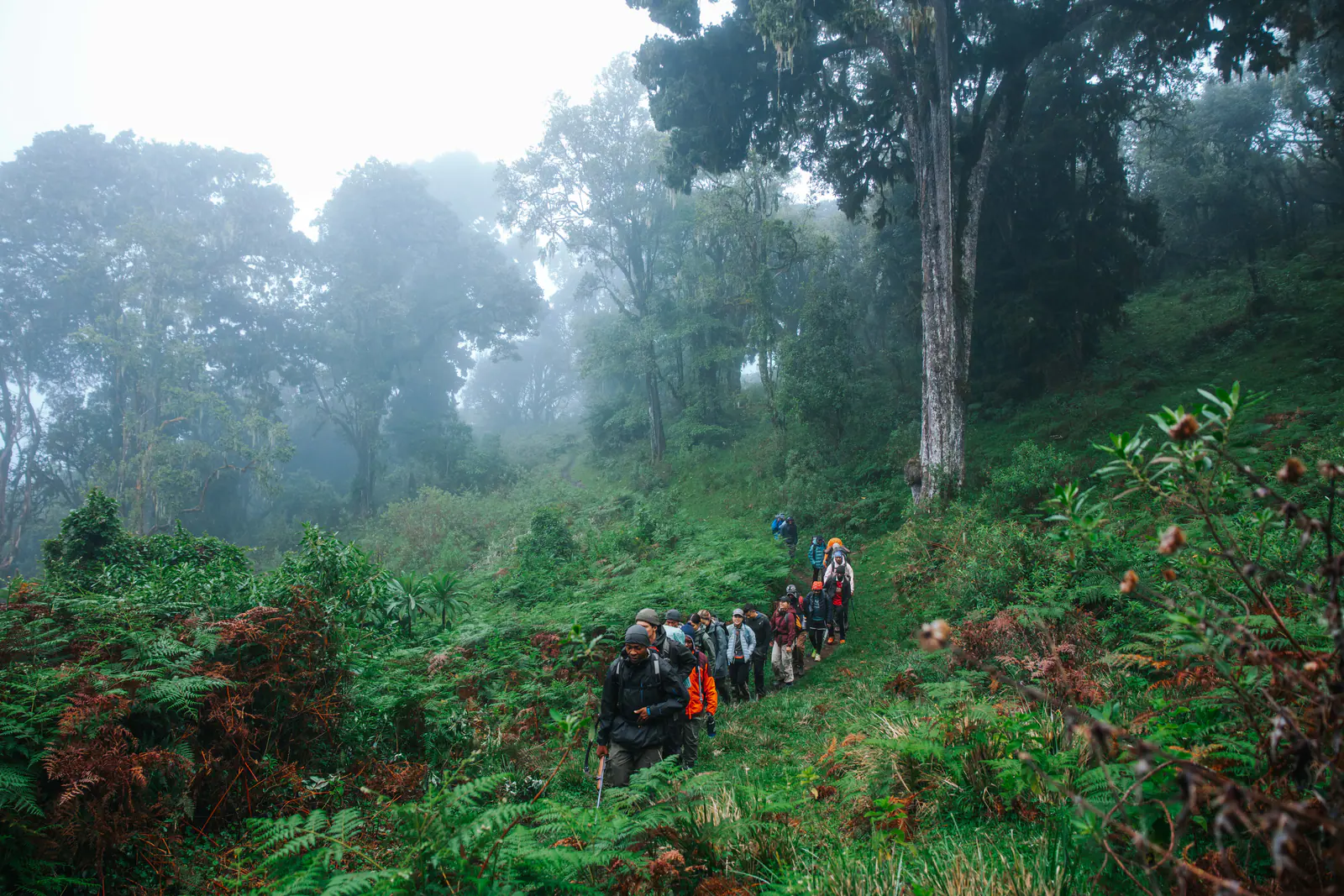
The terrain is genuinely mountainous. Trails climb and drop through valleys, ridgelines and river crossings, and the Uwinka area near the park's centre sits high enough to offer sweeping views across a green sea of forest on clear mornings. Weather changes quickly at this elevation, and mist is a normal part of the experience rather than a sign of a spoiled day.
Because the park stretches across a long north–south axis, different sectors serve different purposes: Uwinka for the canopy walkway and the main trail network, Gisakura for a second reception area and some accommodation, and the Cyamudongo forest fragment for a smaller, separate chimpanzee community.
| Sector | Role | What to expect |
|---|---|---|
| Uwinka | Main reception and trailhead | Canopy walkway, Igishigishigi trail, viewpoint, most day trails |
| Gisakura | Secondary reception and lodging area | Tea estate edge, some accommodation, access to trails |
| Cyamudongo | Separate forest fragment | A smaller, distinct habituated chimpanzee community |
| Kitabi | Southern access point | Community and cultural context, entry from the south |
Uwinka
- Role
- Main reception and trailhead
- What to expect
- Canopy walkway, Igishigishigi trail, viewpoint, most day trails
Gisakura
- Role
- Secondary reception and lodging area
- What to expect
- Tea estate edge, some accommodation, access to trails
Cyamudongo
- Role
- Separate forest fragment
- What to expect
- A smaller, distinct habituated chimpanzee community
Kitabi
- Role
- Southern access point
- What to expect
- Community and cultural context, entry from the south
03 / 11
A UNESCO World Heritage property since 2023
Nyungwe National Park was inscribed on the UNESCO World Heritage List as a natural property in September 2023, the first site in Rwanda to receive that status ¹. The listing describes it as a serial property important for Central African rainforest conservation, home to intact forest and peat-bog habitats and to globally threatened species such as the Eastern chimpanzee, the golden monkey and the Critically Endangered Hills horseshoe bat ².
RDB's own announcement confirms that inscription is a statement about completed, permanent World Heritage status, not a proposal under consideration. When researching further, look for wording that reflects the property as inscribed rather than nominated, and treat 2023 as the correct reference year.
For travellers, the designation is a useful trust signal about the significance of what they are visiting, but it does not change day-to-day logistics such as reporting times or permit categories, which are set by Rwanda's park authority.
Nyungwe National Park was inscribed as a natural UNESCO World Heritage property in September 2023: the first Rwandan site on the list. Use inscribed, not nominated, when describing this status.
04 / 11
Biodiversity and primates across the whole park
Nyungwe protects an unusually dense concentration of species for its size. Official sources describe around 13 primate species living in the park, alongside roughly 300 or more recorded bird species, hundreds of butterfly species and a rich orchid flora. This is a forest defined by layered habitat: canopy, understorey, bamboo zone, peat bog and open moorland all sit within the same boundary.
Primates range from chimpanzees and the golden-shouldered L'Hoest's monkey to large troops of Ruwenzori colobus, some of the biggest arboreal primate groups recorded anywhere in Africa. Many visitors see several primate species on ordinary forest trails without booking a dedicated tracking permit, simply because the forest is that alive.
This ecological richness, well suited to a Rwanda photography safari, is why Nyungwe should not be reduced to a single headline activity. Its biodiversity is the reason the canopy walk, general trail network and birding routes are worth planning time around, in addition to any primate tracking.
-
13 primate species
From chimpanzees to Ruwenzori colobus troops and L'Hoest's monkeys, seen across multiple trail types.
-
300+ recorded bird species
A serious destination for Albertine Rift endemics and forest birding.
-
Orchids and butterflies
Hundreds of orchid and butterfly species add to short-trail interest, not just headline wildlife.
-
Layered habitat
Peat bogs, bamboo, high forest and moorland sit inside one park boundary.
05 / 11
Match the activity to the day you want
Nyungwe's activity list is broader than most visitors expect. Beyond chimpanzee tracking, official and park-affiliated operators offer the canopy walkway, a range of graded hiking trails, birding walks, monkey tracking for species other than chimpanzees, waterfall hikes and visits to tea landscapes bordering the park.
Use the selector below as a starting point for matching mood, time and physical effort to an activity, then confirm current timing and cost at the Uwinka or Gisakura reception centre before booking.
Canopy walkway
- Length
- About an hour's walk in via the Igishigishigi trail, plus the walkway itself
- Feel
- A suspended bridge over a forested ravine with treetop views
- Good for
- A shorter, high-impact half-day activity that suits most fitness levels
Confirm current departure times, fees and trail conditions at reception before choosing on the day.
06 / 11
The canopy walkway in more detail
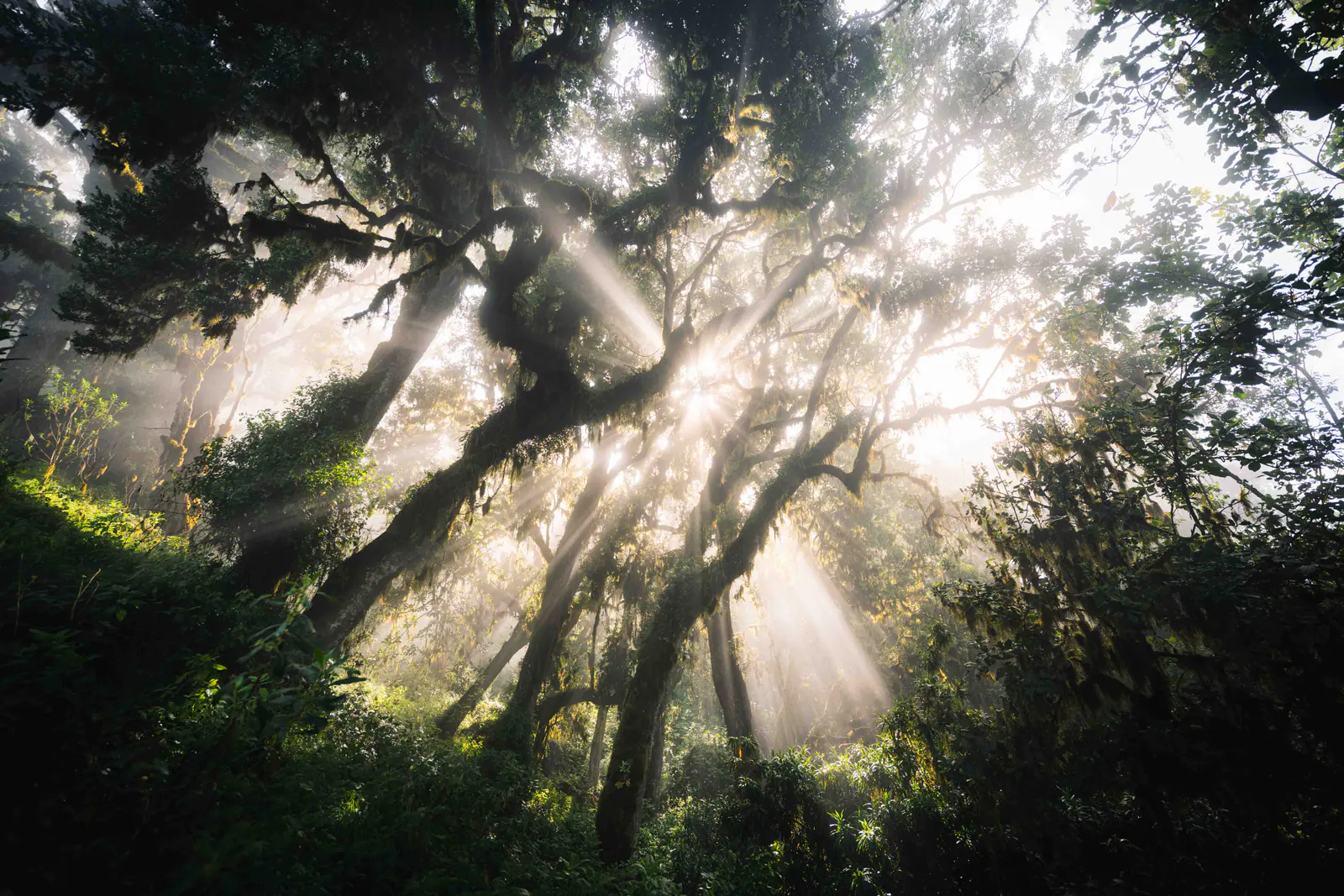
Shafts of light through twisted forest trees in mist.
The canopy walkway is a suspended bridge over a forest ravine, reached on foot from the Uwinka Reception Centre along the Igishigishigi trail. Visit Rwanda describes it as roughly 160 metres long and around 70 metres above the ravine floor, accessible as part of a guided tour along that trail or combined with longer hikes such as the Imbaraga or Umuyove trails ³.
The walk in takes about an hour and passes through genuinely rich forest, with a real chance of seeing birds, butterflies and orchids even before reaching the bridge. Paths are well maintained but can be muddy, particularly after rain, so footwear matters as much as it does for a tracking day.
Because the canopy walkway has its own separate fee structure from chimpanzee or other primate permits, it can be added to almost any Nyungwe itinerary without competing for a tracking slot, and it works well as a standalone half-day activity for travellers not doing a primate trek at all.
07 / 11
Where Nyungwe fits in a Rwanda circuit
Nyungwe sits in the far southwest, which makes it a natural bookend to a Rwanda itinerary rather than a quick detour. Most travel plans link it either to Kigali directly, to Lake Kivu along the western shore road, or occasionally onward toward the Burundi border for those continuing a wider regional trip.
Because of the distance from Volcanoes National Park in the north, combining gorilla or golden monkey tracking with Nyungwe usually means treating the country as a loop: north for primates and volcanic scenery, south for rainforest, with Kigali or Lake Kivu absorbing the transition.
Illustrative route only: Kigali arrival, Volcanoes National Park for two to three nights, transfer south via Lake Kivu for one or two nights, then Nyungwe for two nights before returning to Kigali for departure. Adjust the sequence around flight timing and permit dates rather than treating this as a fixed plan; the Rwanda itinerary guide walks through this kind of sequencing in more depth.
| Approach | Typical routing | Best suited to |
|---|---|---|
| Direct from Kigali | A half-day drive south, then two or more nights | Travellers prioritising Nyungwe alone or with limited time |
| Via Lake Kivu | Kigali to Kivu, then south along the western shore to Nyungwe | A full west-of-Rwanda loop with lake downtime included |
| Full north–south circuit | Volcanoes in the north, Nyungwe in the south, connected via Kigali or Kivu | Longer trips combining primates, savannah or rainforest across the country |
Direct from Kigali
- Typical routing
- A half-day drive south, then two or more nights
- Best suited to
- Travellers prioritising Nyungwe alone or with limited time
Via Lake Kivu
- Typical routing
- Kigali to Kivu, then south along the western shore to Nyungwe
- Best suited to
- A full west-of-Rwanda loop with lake downtime included
Full north–south circuit
- Typical routing
- Volcanoes in the north, Nyungwe in the south, connected via Kigali or Kivu
- Best suited to
- Longer trips combining primates, savannah or rainforest across the country
08 / 11
How long to stay
A single night can cover one activity, such as the canopy walk or one primate tracking session, but it leaves no slack for weather delays or a second experience. Two nights is a common illustrative shape: it allows one primate morning and one additional activity such as the canopy walk or a birding trail.
Three nights suit travellers who want chimpanzee tracking, the canopy walkway and a slower hiking day, or who want to build in a buffer for a rained-out morning. Given Nyungwe's size and the range of trail lengths, a longer stay rewards travellers more than it does at a smaller, single-activity park.
-
1 night
Enough for a single activity; little room for weather delay.
-
2 nights
An illustrative balance of one primate morning and one further activity.
-
3 nights
Room for chimpanzee tracking, the canopy walk and an unhurried hiking day.
09 / 11
Seasonality in a rainforest, not a savannah
Nyungwe is a rainforest, so rain is a normal year-round feature rather than an occasional inconvenience. As set out in the best-time-to-visit guide, Rwanda's broader seasonal pattern still applies: rains are broadest roughly mid-February to May and mid-September to mid-December, with the named dry season running from June to mid-September, per Visit Rwanda's weather guidance. The weeks around December and January fall outside the named rainy periods but are not classified as an official second dry season.
Trails can be muddy in any month, and forest canopy means rain gear matters more here than in open savannah parks. Drier months tend to bring firmer trails and slightly easier canopy-walk conditions, but wetter months can bring dramatic mist and lush colour that many photographers prefer.
- Trail tendency
- Prepare for
Jan
- Trail tendency
- Firmer
- Prepare for
- Demand
Feb
- Trail tendency
- Variable
- Prepare for
- Mixed weather
Mar
- Trail tendency
- Muddier
- Prepare for
- Rain gear
Apr
- Trail tendency
- Muddier
- Prepare for
- Rain gear
May
- Trail tendency
- Muddier
- Prepare for
- Rain gear
Jun
- Trail tendency
- Firmer
- Prepare for
- Demand
Jul
- Trail tendency
- Firmer
- Prepare for
- Demand
Aug
- Trail tendency
- Firmer
- Prepare for
- Demand
Sep
- Trail tendency
- Variable
- Prepare for
- Transitions
Oct This month
- Trail tendency
- Muddier
- Prepare for
- Rain gear
Nov
- Trail tendency
- Muddier
- Prepare for
- Rain gear
Dec
- Trail tendency
- Variable
- Prepare for
- Holiday demand
10 / 11
Getting there and organising the day
Nyungwe is reached by road, typically via Huye (Butare) from Kigali, on a route that itself passes through changing landscape from hills to tea country. There is no scheduled public transport built for tourist timing, so Visitors can arrive by private vehicle, tour operator transfer or self-drive.
Reception and permit registration for most activities runs through the Uwinka or Gisakura centres. Bring rain protection regardless of season, wear broken-in boots with grip as detailed in the Rwanda safari packing list, and confirm the current start time and meeting point for any booked activity rather than assuming a fixed schedule.
-
Book activities ahead
Confirm chimpanzee, other primate or canopy-walk slots before travelling; some are capacity-limited.
-
Base near Uwinka or Gisakura
Staying close to the reception centre used for your activity avoids a long pre-dawn transfer.
-
Check in and confirm the plan
Reception centres confirm the day's exact timing, trail conditions and any changes.
-
Pack for wet forest, not dry savannah
Waterproof layers, boots and a protected camera bag matter more here than sun protection.
11 / 11
Accommodation logic near the park
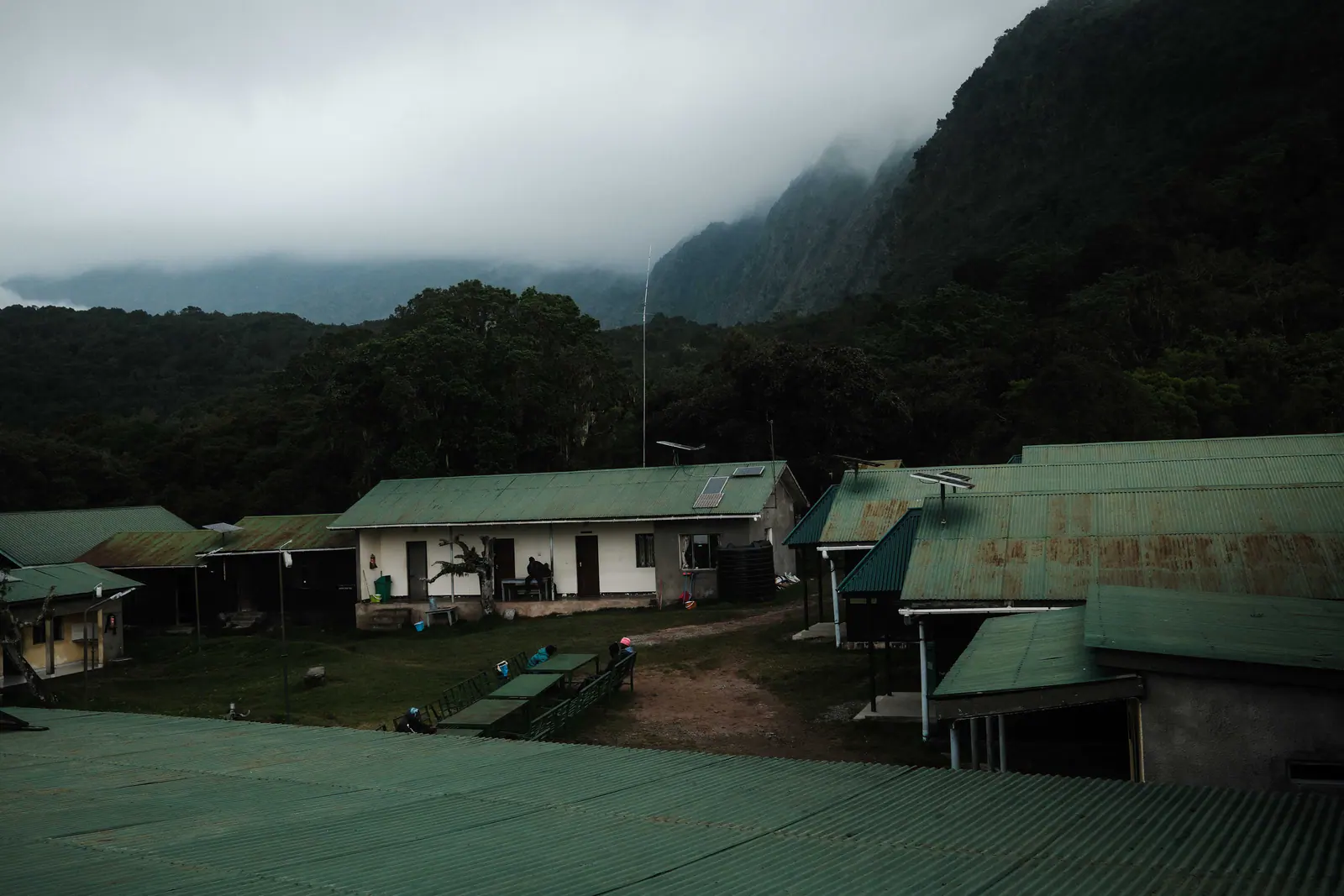
Green-roofed buildings under low cloud at the edge of the forest, with steep wooded slopes rising behind.
Lodging options sit near the Gisakura and Uwinka areas and range from simple park-affiliated guesthouses and campsites to more comfortable forest-edge lodges. This guide does not name specific properties or quote rates; see the Rwanda safari lodges guide for how to evaluate current, verified options.
Choose a base close to the reception centre for your planned activity to protect an early morning start, and confirm transfer times between accommodation and trailhead before booking rather than assuming proximity.
Planned by people who live the route
UNESCO World Heritage Centre and official destination sources checked
- Locally based in Tanzania
- East Africa route specialists
- Licensed and insured operator
- Fast, direct answers
- Read Safari Soles reviews on TripAdvisor
- Read Safari Soles reviews on SafariBookings
- Read Safari Soles reviews on Google
Where these facts come from (5)
- UNESCO World Heritage Centre: Nyungwe National Park Official World Heritage inscription description and status
- RDB: Nyungwe UNESCO inscription announcement Official confirmation of the 2023 inscription and park statistics
- Visit Rwanda: Canopy Walkway Official canopy walkway description, access and cost bands
- Visit Rwanda: Primate Tracking Official destination overview
- Visit Rwanda: Weather Official country seasonal context
Related Safari Soles guides
Continue with the guides travellers usually read next.
 Chimpanzee Trekking in Rwanda Prepare for the pace, terrain and forest context of chimpanzee tracking in Nyungwe. Primates & Rainforest
Read the guide
Chimpanzee Trekking in Rwanda Prepare for the pace, terrain and forest context of chimpanzee tracking in Nyungwe. Primates & Rainforest
Read the guide
 Rwanda Safari Understand Rwanda's landscapes, experiences, seasons and the decisions that shape a complete first trip. Trip Planning
Read the guide
Rwanda Safari Understand Rwanda's landscapes, experiences, seasons and the decisions that shape a complete first trip. Trip Planning
Read the guide
- Best Time to Visit Rwanda Compare rain, trail conditions, wildlife priorities and route trade-offs across the year. Trip Planning
Read the guide
Frequently Asked Questions
-
No. Chimpanzee tracking is one activity among several, including the canopy walkway, hiking trails, birding and other primate tracking.
Give Nyungwe the two to three nights its range of activities deserves.
Pair the canopy walkway, trails and birding with a tracking morning, and connect it to the rest of Rwanda through Kigali or Lake Kivu.