


Luxury Rwanda Safari: Journey Design, Transfers & Pace
What premium spend actually changes on a Rwanda safari: journey design, private transfers, helicopter options where verifiable, pacing and planning lead times. Property selection lives on the lodges guide.
- Standard foreign adult permit
- US$1500
- Road transfer
- roughly 2.5–3 hours
- Helicopter transfer
- roughly a timing confirmed by the helicopter operator
- Planning priority
- Secure fixed-capacity activities well ahead
Written and maintained by the Safari Soles planning team in Arusha, Tanzania.
Luxury does not change the gorilla encounter rules or the rate for a traveller's eligible RDB category.
- Set by RDB by visitor category: Permit price, age rule, group size, one-hour encounter
- Variable by budget: Transfers, pacing, privacy, service continuity
- Verifiable upgrade: Helicopter transfer on the Kigali–Volcanoes route
- Plan first: Gorilla permit date, then everything else
01 / 10
What luxury actually changes on a Rwanda safari
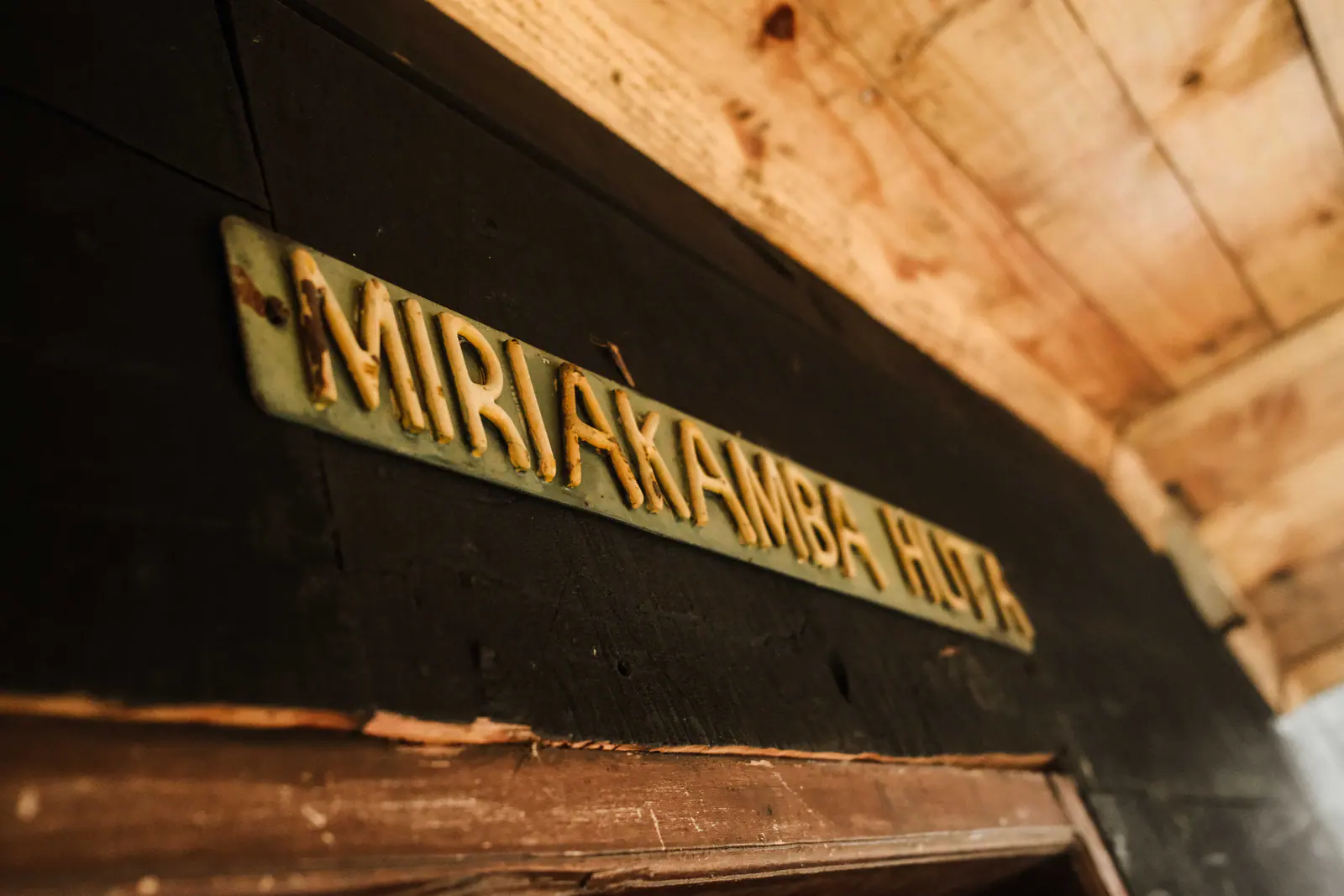
A wooden door frame under a painted sign that reads Miriakamba Hut.
The standard foreign-adult gorilla permit is US$1,500, while RDB publishes different eligible rates for certain resident, citizen and African categories. Luxury does not buy a different gorilla family, a longer hour or a private trail. What it changes is everything around that fixed core: how you travel between activities, how much of each day is compressed or unhurried, how much of the itinerary is exclusive to your party, and how much friction is removed from logistics, weather, health and last-minute changes.
This guide is about that surrounding layer (journey design, transfers, pacing and service) not about which specific lodge to book. Property selection, star ratings and named comfort levels belong on the dedicated lodges guide; this page assumes you already know you want a premium trip and explains what premium spend is actually purchasing.
Treat luxury as a set of decisions rather than a price tag: fewer one-night stops, private vehicles and guides instead of shared transport, optional air transfers where they exist, and a planning lead time long enough to secure the dates and permits that make the rest possible.
02 / 10
How premium journeys are actually designed
A well-designed high-end Rwanda itinerary starts from the fixed points (the gorilla permit date, an international flight schedule) and builds outward, rather than starting from a list of places to visit. Because Rwanda is compact, a premium trip can have fewer stops than a comparable budget trip, not more: two or three bases (Kigali, Volcanoes, one further region) rather than a different bed every night.
Each move between regions is a full transfer, whether by road or air, so the design question is how many moves the trip can absorb without feeling like transit. A common premium structure sequences an arrival night in Kigali, several nights in the Volcanoes region built around one or two primate mornings, then a slower chapter (Lake Kivu, Nyungwe or Akagera) before departure. This is an illustrative route, not a fixed package.
Where the trip extends beyond Rwanda, sequencing matters more than distance: Rwanda's forest pace suits opening or closing a journey, while a savannah chapter in Tanzania or Kenya, or a beach chapter in Zanzibar, is usually placed as a distinct movement rather than squeezed between forest mornings.
-
Anchor the fixed dates
Confirm the gorilla permit date and any other fixed booking before shaping anything else.
-
Choose the number of bases
Decide how many regions the trip can comfortably hold without over-compressing transfers.
-
Sequence forest, water and savannah
Alternate activity intensity so the pace itself becomes part of the design.
-
Place any extension
Treat Tanzania, Kenya or Zanzibar as its own chapter with its own transfer, not an afterthought.
03 / 10
Private road transfers and helicopter options
The clearest, verifiable luxury lever in Rwanda is how you move between Kigali and the Volcanoes region. The standard route is a private road transfer of roughly 2.5–3 hours through hill country. Several operators and at least one lodge with its own helipad also offer helicopter transfers on this route, typically cited at around a timing confirmed by the helicopter operator depending on the exact departure and landing points.
A helicopter transfer removes a half-day of road time and adds an aerial view of Rwanda's terraced hills as part of the experience itself, which is genuinely different from a scenic drive rather than only faster. It also depends on weather, aircraft availability and specific lodge landing arrangements, so it should be booked and reconfirmed well ahead of arrival rather than assumed as a default option.
Between other regions (to Lake Kivu, Nyungwe or Akagera) private road transfer with a dedicated vehicle and driver-guide is the realistic premium standard; do not assume a helicopter network covers every route in the country. Confirm current routes, minutes and pricing directly with a licensed operator before including one in a plan.
| Mode | Approximate time | What it changes |
|---|---|---|
| Private road transfer | roughly 2.5–3 hours | Standard premium option; scenic but uses a half day |
| Helicopter transfer | roughly a timing confirmed by the helicopter operator | Verifiable option with select operators/lodges; weather- and availability-dependent |
| Shared road transport | Similar driving time, shared vehicle | Not the premium tier; less flexibility and privacy |
Private road transfer
- Approximate time
- roughly 2.5–3 hours
- What it changes
- Standard premium option; scenic but uses a half day
Helicopter transfer
- Approximate time
- roughly a timing confirmed by the helicopter operator
- What it changes
- Verifiable option with select operators/lodges; weather- and availability-dependent
Shared road transport
- Approximate time
- Similar driving time, shared vehicle
- What it changes
- Not the premium tier; less flexibility and privacy
04 / 10
Pacing: fewer moves, more usable time
The single biggest difference a premium budget buys is time protected from logistics. A rushed itinerary schedules a trek, a same-day transfer and a flight in one day; a well-paced one gives each activity its own morning and keeps travel days free of fixed appointments. This is a scheduling decision, not a spending decision, but it is much easier to execute with a private vehicle and flexible booking than with fixed shared transport.
Two nights per stop is a reasonable floor for any region hosting a primate activity, because trek finish times are never guaranteed and a same-day onward departure risks the whole plan. Three nights allow a rest morning, a second activity, or simply slower mornings without an alarm built around a park report time.
Pacing also means accepting that Rwanda does not reward trying to see everything. A tighter, better-paced circuit of two or three regions consistently reads as more premium in practice than a longer circuit that keeps every day tightly scheduled.
-
One activity per day
Avoid stacking a trek, a transfer and a flight into a single calendar day.
-
Buffer night after treks
Keep the night after any primate activity free of a fixed onward departure.
-
Fewer, longer stops
Two or three regions with real time in each outperform a longer list of one-night stays.
-
Same-day connections
Avoid scheduling international flights the same day as a forest activity.
05 / 10
Where exclusivity is real, and where it is not
Gorilla trekking itself is not exclusive: group size and encounter rules do not change with budget, while permit price follows the visitor's eligible RDB category. What premium planning can secure is a private vehicle and guide for the whole trip rather than joining a shared group vehicle, a preferred permit date secured well ahead, and sole use of a private vehicle on transfer days.
Some operators can request specific trek preferences (for example, a family group suited to a chosen fitness level) through the booking process, but final trek allocation is an RDB and park operations decision on the day, not something any operator or lodge can guarantee in advance.
Genuine exclusivity in Rwanda tends to come from timing and access rather than a separate experience: travelling in a quieter shoulder period, securing a preferred sunrise slot for an activity, or a private vehicle that lets the group leave, pause or extend at its own pace, rather than a fundamentally different version of the gorilla encounter.
06 / 10
Service and logistical comfort in practice
A private driver-guide for the length of the trip is the most consistent marker of a well-run premium Rwanda itinerary: the same person handles airport meet-and-greet, daily transfers, local knowledge and problem-solving if plans change. This differs from a package where transport is subcontracted separately at each stage.
Practical comfort also includes contingency planning: a buffer day before an international departure, pre-arranged porter and rain-gear logistics for trek mornings, and a operator who can rearrange a day if weather, health or a permit issue interrupts the plan. None of this changes the trek itself, but it changes how much of the trip's stress the traveller has to manage personally.
Ask any operator directly how transfers, guiding and problem-resolution are structured, rather than assuming 'luxury' language in marketing automatically means a private guide throughout. Confirm before booking, in writing.
-
Dedicated driver-guide throughout
One person, one vehicle, consistent local knowledge for the full trip.
-
Buffer days around fixed activities
Protects the trek and the international departure from each other.
-
Flexible permit-date booking lead time
Access to preferred dates rather than whatever remains close to travel.
-
Private vehicle vs shared transport
Removes shared-schedule constraints on transfer days.
-
Optional helicopter transfer
Verifiable time saving on the Kigali–Volcanoes route where offered.
-
Porter and rain-kit coordination
Removes small but real friction on trek mornings.
07 / 10
Compose a premium journey by priority
Different travellers spend a premium budget on different priorities. Use this composer to see how three common priorities change the shape of the same core Rwanda trip: it illustrates trade-offs, not a bookable package.
Saving time
- Transfer choice
- Helicopter where offered; private vehicle elsewhere
- Base count
- Fewer regions, longer stays in each
- Trade-off
- Weather- and availability-dependent; confirm well ahead
Every path still uses the same dated gorilla-permit conditions; only the surrounding design changes.
08 / 10
High-end combinations that make sense
Rwanda's forest experiences pair naturally with a classic savannah chapter, because the two are visually and physically different rather than repetitive. A premium combination might place three or four nights in Rwanda around the gorilla permit, then fly to the Serengeti or Maasai Mara for open-plains game viewing, or on to Zanzibar for a beach close.
Each leg of a combination trip needs its own transfer and its own pacing logic; do not treat a regional flight as equivalent to a one-hour domestic transfer. Build in an arrival buffer at each new country, particularly where entry requirements or connecting flight schedules differ.
This guide does not publish flight schedules, connection times or country-specific visa rules for a combination trip; confirm current requirements for every country in the plan before booking.
09 / 10
Planning priorities and lead times
For any premium trip built around gorilla trekking, the permit date is the first constraint, not the last. High-demand periods can have limited live availability, and a private-guide, small-footprint premium trip needs the same permit lead time as a budget one: money does not create additional permits.
Check live permit, lodge and transfer availability as soon as dates are fixed against current seasonal guidance; no official monthly sell-out timeline is published. Helicopter transfers, specific vehicle configurations and preferred trek-date requests should be confirmed early rather than assumed available on short notice.
Passport validity, any required travel documentation and vaccination guidance should be checked against the Rwanda entry requirements guide and current official sources well before departure; this guide does not restate visa rules that vary by nationality.
- First
Confirm the permit date
Book the gorilla permit date first; every other premium decision follows from it.
- After the permit
Lock transfers and vehicle
Reserve private vehicles and request any helicopter transfer while availability is open.
- Then
Confirm documentation
Check current entry requirements and any required health guidance for every country on the route.
- Before departure
Reconfirm logistics
Reconfirm helicopter weather policy, driver-guide details and any extension flights.
10 / 10
Who a premium Rwanda journey actually suits
This tier of planning suits travellers who value time protected from logistics, a private guide and vehicle for the full trip, and a smaller number of unhurried stops over a longer checklist of places visited. It also suits travellers combining Rwanda with a further African chapter and wanting each leg handled without gaps.
It suits less well a traveller mainly seeking the lowest possible cost per day, since the permit cost can be a major part of the budget regardless of tier; the lodges guide and cost guide are better starting points for that comparison, or start from the custom safari planning page if you want help shaping the trip directly.
Planned by people who live the route
Fixed RDB permit rules and official destination guidance checked
- Locally based in Tanzania
- East Africa route specialists
- Licensed and insured operator
- Fast, direct answers
- Read Safari Soles reviews on TripAdvisor
- Read Safari Soles reviews on SafariBookings
- Read Safari Soles reviews on Google
Where these facts come from (4)
- RDB: Mountain gorilla tracking Category-specific permit rates, minimum age and reporting rules that apply at every budget tier
- Visit Rwanda: Volcanoes National Park Official destination and transfer context
- Visit Rwanda: Getting around Official domestic travel and transfer context
- Visit Rwanda: Weather Seasonal planning context for lead times
Related Safari Soles guides
Continue with the guides travellers usually read next.
 Rwanda Safari Lodges Choose where to spend for position, recovery, atmosphere and the pace of the route. Trip Planning
Read the guide
Rwanda Safari Lodges Choose where to spend for position, recovery, atmosphere and the pace of the route. Trip Planning
Read the guide
 Rwanda Safari Cost Build a realistic budget from permits, nights, private transport, parks and comfort choices. Trip Planning
Read the guide
Rwanda Safari Cost Build a realistic budget from permits, nights, private transport, parks and comfort choices. Trip Planning
Read the guide
 Rwanda Itinerary: How Many Days? Compare focused and complete route shapes without forcing every region into one journey. Trip Planning
Read the guide
Rwanda Itinerary: How Many Days? Compare focused and complete route shapes without forcing every region into one journey. Trip Planning
Read the guide
Frequently Asked Questions
-
No. The standard foreign adult rate is US$1,500; RDB publishes other eligible categories. Group size, encounter duration and minimum age follow the booked product rules.
Lock the permit date first, then design the pace around it.
Confirm the gorilla permit date, then choose transfers, vehicle and lodging tier with a licensed operator who can hold a private itinerary together.