Neither mountain requires ropes, harnesses, crampons, or ice axes on its standard routes, so both are officially “non-technical” treks. But non-technical doesn’t mean the terrain is the same, and this is where Mount Meru surprises people.
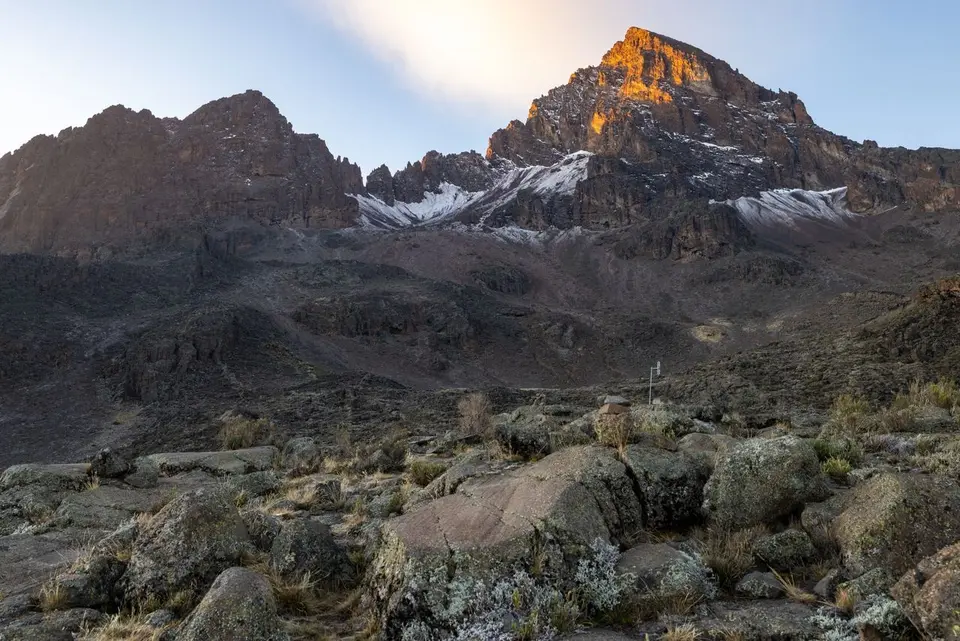
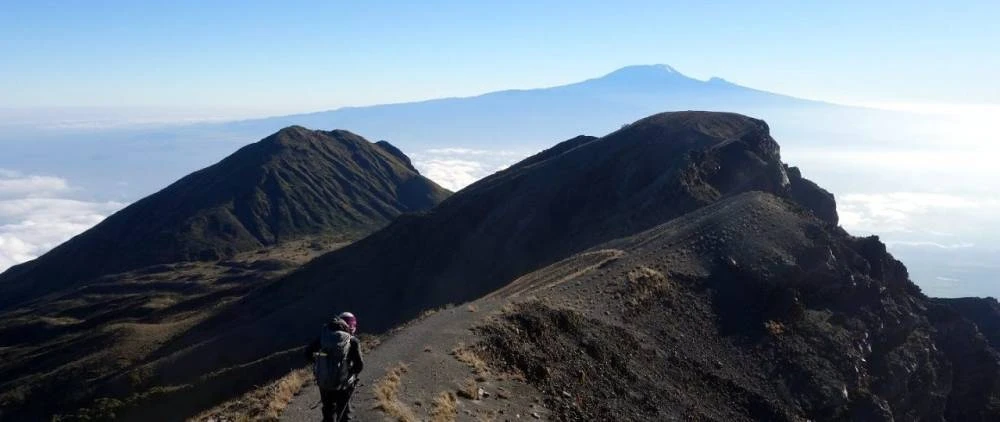
Meru’s summit route is steep, loose volcanic ash and rock. Above Rhino Point (about 3,800 m / 12,467 ft), the trail narrows onto an exposed ridge along the crater rim and continues past Cobra Point (about 4,350 m / 14,271 ft) to Socialist Peak, with a steep drop into the crater on one side and some sections where you’ll use your hands for balance.
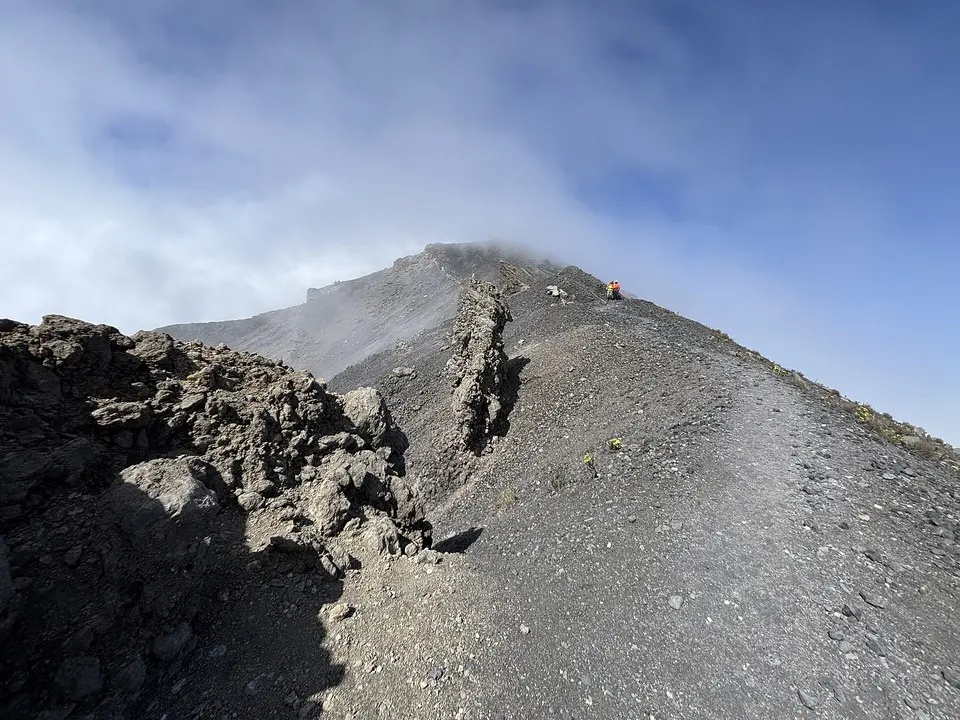
The exposed ridge on the way to Mount Meru's summit. AmyAbroad / CC BY-SA 4.0
Kilimanjaro’s most technical moment on the popular routes is the Barranco Wall, a short, steep scramble on the Machame, Lemosho, Shira, and Umbwe routes. It’s non-technical, but you may need to use your hands. Beyond that, the climb is mostly a long walk on rocky paths and, on summit night, loose scree. The Western Breach variation adds more serious scrambling on fragmented rock and is generally reserved for experienced trekkers. The Western Breach is often closed due to rockfalls, and you’ll need a special waiver to access it.
So where does “non-technical” mislead? On Meru, the exposure can feel pretty serious, especially on a narrow ridge in the dark. On Kilimanjaro, the difficulty isn’t the terrain at all; it’s endurance, cold, and thin air.
The Summit Push: Meru’s Ridge vs Kilimanjaro’s Summit Night
Summit day is the hardest day on both mountains, but they’re very different challenges.
On Meru, you wake around midnight or 12:30 a.m. and start climbing from Saddle Hut (about 3,570 m) between 1 and 2 a.m. It takes about 4 to 5 hours to reach Socialist Peak, roughly 5 km (3 mi) away, arriving at sunrise with Kilimanjaro glowing in the distance. After a short stop at the top, you descend to Saddle Hut for a rest, then continue down to Miriakamba Hut. Our shorter 3-day itineraries head straight down to Arusha, making for a 10-to-12-hour day, while our longer 4-day climbs spend the night at the Miriakamba Hut.
On Kilimanjaro, summit night starts around midnight from high camp (around 4,673 m). It takes roughly 6 to 8 hours to reach Uhuru Peak along a slow, zigzagging scree trail in subzero temperatures, then descend to Mweka Camp at around 3,100 m (10,170 ft), so summit day can last 12 hours or more. The air at the top holds roughly half the oxygen of sea level. In one study of the Machame route, 86% of trekkers had AMS on summit day.
In short, Meru’s summit push is shorter, steeper, more exposed, and at a lower altitude. Kilimanjaro’s is longer, colder, and far thinner on oxygen.