


Tanzania Safari Cost
What actually shapes the price of a Tanzania safari — season, route length, parks, accommodation, vehicle setup and group size — and how to get a quote you can trust.
- Local Tanzania team
- Private safari planning
- Real Safari Soles routes
Planning Guide
Tanzania safari cost depends on season, number of days, parks, accommodation level, private vehicle setup, group size and whether you drive or fly. For accurate pricing, send your dates and group size so the route can be checked against real lodge availability.
- Accommodation tier is the single largest variable
- Park and conservation fees are charged per person, per 24 hours
- Peak season (Jul–Oct) carries the highest lodge rates
- Larger groups share the vehicle and guide, lowering per-person cost
- Flights add cost but can remove long drive days
- There is no single Tanzania safari price: the same seven days can differ enormously depending on season, lodge tier and how many parks you cover.
- Park and conservation fees are fixed government charges per person per 24 hours, so they scale with people and nights rather than with comfort level.
- Accommodation is the biggest lever you control — moving one tier changes the total far more than shaving a day off the route.
- Private vehicles are charged to the group, so cost per person falls sharply from two travellers to four or six.
- Peak season (July to October) carries the highest rates and needs the earliest booking; green season is the quietest and best value.
- Flying between parks adds a transport line but can remove long transfer days, occasionally lowering the total trip cost.
- Only real dates, real group size and live lodge availability produce a number you can rely on.
Safari cost estimator
Adjust the factors below to see what pushes your safari cost up or down. This is planning guidance, not a price — confirmed rates depend on live availability.
Upper-middle cost pressure for 2 travellers over 7 days
Safari Soles quotes against live lodge availability, so we share confirmed pricing rather than estimates.
- Peak-season lodge rates and park pressure raise the total noticeably.
- A private vehicle is charged to your group, so smaller groups carry more of it.
- With two travellers, the vehicle and guide are split across fewer people.
- Mid-range lodges give the best comfort-per-dollar on the northern circuit.
- Driving avoids flight costs but uses more of your safari days.
What affects the price most
Cost factor impact (1 = minor, 5 = major)
Planning scores from 1 (low) to 5 (high)
Relative planning weights based on typical Tanzania itineraries, not price figures.
For first-time travellers, the cheapest itinerary is rarely the best value. Spending slightly more on lodges inside the park usually buys back one to two hours of wildlife time every single day.
Cost by season, days and comfort level
| Season | Rate pressure | What you get |
|---|---|---|
| Peak (Jul–Oct) | Highest | Best visibility, river-crossing window, busiest parks |
| Shoulder (Jan–Feb, Jun, Dec) | Medium-high | Calving season or early dry season with fewer vehicles |
| Green (Mar–May, Nov) | Lowest | Green landscapes, quiet parks, some camps closed |
- Rate pressure
- Highest
- What you get
- Best visibility, river-crossing window, busiest parks
- Rate pressure
- Medium-high
- What you get
- Calving season or early dry season with fewer vehicles
- Rate pressure
- Lowest
- What you get
- Green landscapes, quiet parks, some camps closed
| Accommodation | Cost level | Typical experience |
|---|---|---|
| Camping | Lean | Public or private campsites, shared facilities |
| Mid-range lodge | Middle | Comfortable rooms, pools, good locations |
| Premium tented camp | Upper | Inside the parks, closer to wildlife, fewer rooms |
| Luxury / exclusive | High | Private guiding, exclusive areas, top-tier service |
- Cost level
- Lean
- Typical experience
- Public or private campsites, shared facilities
- Cost level
- Middle
- Typical experience
- Comfortable rooms, pools, good locations
- Cost level
- Upper
- Typical experience
- Inside the parks, closer to wildlife, fewer rooms
- Cost level
- High
- Typical experience
- Private guiding, exclusive areas, top-tier service
| Trip length | Cost effect | Planning note |
|---|---|---|
| 3–4 days | Lowest total | Northern parks close to Arusha only |
| 5–7 days | Balanced | The classic circuit with sensible pacing |
| 8–12 days | Higher total | Adds northern Serengeti or a second circuit |
- Cost effect
- Lowest total
- Planning note
- Northern parks close to Arusha only
- Cost effect
- Balanced
- Planning note
- The classic circuit with sensible pacing
- Cost effect
- Higher total
- Planning note
- Adds northern Serengeti or a second circuit
| Setup | Cost effect | Planning note |
|---|---|---|
| Drive vs fly | Flights add a line | Can remove a full drive day to the north |
| Private vs group | Private costs more per person | Group departures share the vehicle |
| Group size | Larger = cheaper per person | Four-plus travellers spread fixed costs |
- Cost effect
- Flights add a line
- Planning note
- Can remove a full drive day to the north
- Cost effect
- Private costs more per person
- Planning note
- Group departures share the vehicle
- Cost effect
- Larger = cheaper per person
- Planning note
- Four-plus travellers spread fixed costs
Want the real number for your dates? We check live availability before quoting.
How Safari Soles prices a safari
- 01
We check your dates
Availability in the parks you want decides what is genuinely bookable.
- 02
We build the route
Nights per park, drive times and transfers are shaped around your priorities.
- 03
We price real lodges
Every line is a named property at its current contracted rate.
- 04
We confirm in writing
You receive the full inclusion list, terms and payment schedule.
Understanding every line of a Tanzania safari quote
A safari quote is not one price. It is a stack of fixed government charges, contracted bed rates and vehicle logistics. Once you can see the stack, comparing two quotes becomes straightforward.
Park and conservation fees: the part nobody can discount
Tanzania's national parks, the Ngorongoro Conservation Area and the Wildlife Management Areas all charge entry fees set by government authorities. They are billed per person for each 24-hour period inside the protected area, and no operator — local or international — can reduce them. On a typical northern itinerary these fees are one of the two largest components of the total, sitting alongside accommodation.
Because the charge is per person and per day, fees scale with the shape of your route rather than with your comfort level. A family of four spending three nights in the Serengeti pays substantially more in fees than a couple spending two, even if both stay in identical tents. The Ngorongoro Crater adds a separate vehicle descent fee for each descent, which is why we usually build one full crater morning rather than two half-days.
This is also why adding 'just one more park' is rarely cheap. Each new park introduces a fresh set of daily fees, a transfer, and often a change of lodge with its own minimum-stay rules.
- Fees are per person, per 24 hours, set by the authorities
- Ngorongoro adds a per-vehicle crater descent fee
- More parks and more nights mean proportionally more fees
- Children's rates are lower but still apply from a set age
Accommodation: the biggest lever you actually control
Where you sleep is the single largest variable in a Tanzania safari budget and the one where your decision genuinely changes the number. The range runs from serviced camping through comfortable mid-range lodges, into premium tented camps inside the parks, and finally to small luxury properties with private guiding and exclusive-use areas.
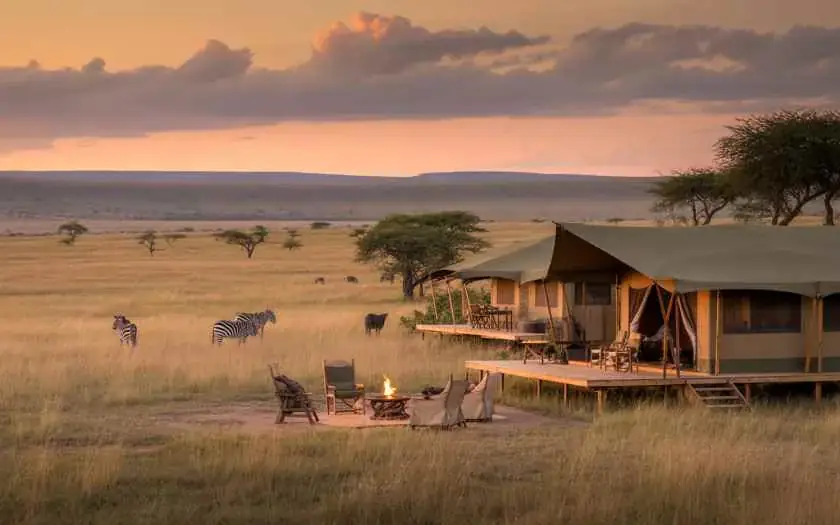
The important distinction is not stars but location. A mid-range lodge sitting inside the park boundary can deliver more wildlife time than a smarter property an hour outside the gate, because you are on the plains at first light rather than still driving toward them. When budget is tight, we would rather protect your position inside the park and moderate the room standard than the other way around.
Seasonal rates layer on top of tier. The same tented camp can move through three or four rate bands across the year, which is why season and accommodation have to be priced together rather than separately.
Vehicle, guide and group size
A private safari means the vehicle, the guide, the fuel and the guide's costs on the road are charged to your group and shared among the travellers in it. That arithmetic is why a private trip feels expensive for two people and very reasonable for six: the same fixed cost simply divides further.
Group departures reduce that per-person share by putting you in a shared vehicle with other travellers, but you trade away control of timing, seat position and how long you linger at a sighting. For photographers, families with young children and anyone with a specific wildlife goal, that trade is usually the wrong one.
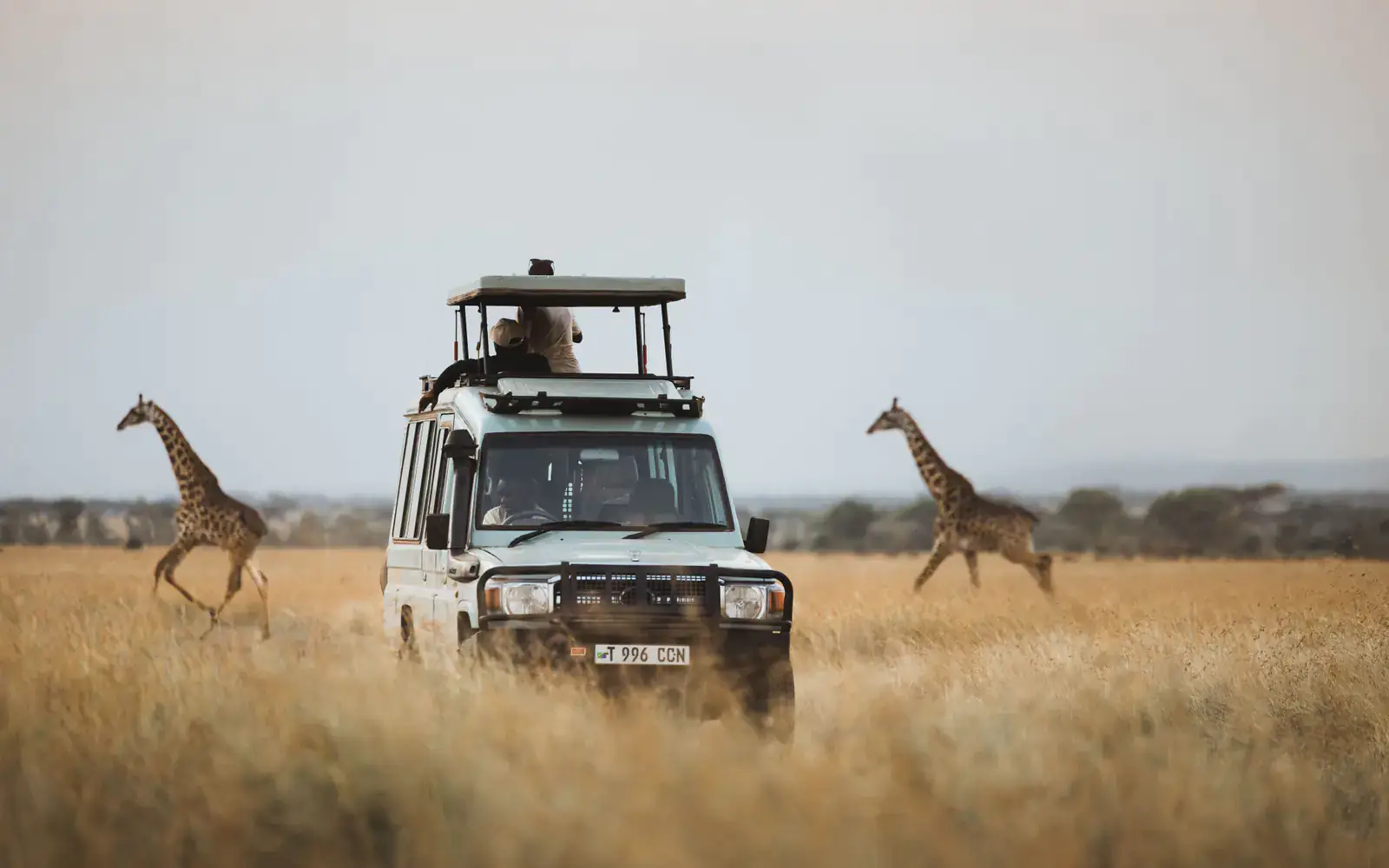
Vehicle standard matters too. A well-maintained 4x4 with a pop-up roof, charging points, a fridge and a guide who knows the park intimately is not the same product as a minibus, even when the itinerary on paper looks identical.
- Two travellers carry the full vehicle cost between them
- Four to six travellers spread it comfortably
- Group departures are cheaper but fix your timing
- Guide quality is the least visible and most valuable line
Driving versus flying between parks
Northern Tanzania can be covered entirely by road, entirely by air, or — most often — as a sensible mix. Driving keeps transport costs low and lets you see the landscape change between the Rift Valley and the Serengeti plains. Flying costs more per sector but removes long transfer days, which matters enormously on routes that reach the northern Serengeti.
The honest comparison is not cost per sector but cost per safari day you actually spend on game drives. A road transfer from the central Serengeti back to Arusha can consume most of a day; the same journey by air takes a fraction of that. On short trips, one flight often buys back an entire day of wildlife viewing.
Bush flights also carry a soft luggage limit of roughly 15kg, so a fly-in route shapes what you pack as much as what you pay.
What sits outside the quote
Most reputable Tanzania quotes exclude the same things, and knowing them prevents surprises. International flights, visa fees, travel insurance, tips for your guide and camp staff, premium drinks, and optional activities such as a balloon flight or a Zanzibar extension are typically separate lines.
We set these out in writing with every quote rather than leaving them implied, because an itinerary that looks cheaper on the first page and hides three excluded items is not actually cheaper.
- International flights and visa fees
- Travel and medical insurance
- Guide and camp gratuities
- Premium drinks and personal items
- Optional balloon flights, walking safaris and beach extensions
The most useful question to ask any operator is not "what is your price?" but "what exactly is in it?" Ask for named lodges, the number of park-fee nights and the vehicle type. Two quotes that differ by a wide margin usually differ on those three lines, not on margin.
How to read this cost guide honestly
Everything on this page is planning guidance rather than a price list. Tanzania lodge rates change by season and by year, park fees are revised by the authorities, and availability in the parks you want decides what is genuinely bookable on your dates. Any figure quoted without your dates and group size is an estimate, not a price.
When you send us dates, we check live availability first and only then build the quote — so the number you receive is one we can actually hold for you.
Send your dates, group size and travel style and we'll return a confirmed, itemised quote.
Common mistakes to avoid
Most disappointing safaris come from a handful of avoidable planning decisions.
- 01
Comparing quotes on price alone
Two quotes rarely include the same lodges, park nights or vehicle standard. Compare the inclusions line by line.
- 02
Ignoring park fees in the maths
Fees are per person per 24 hours. An extra park night costs far more than just the bed.
- 03
Choosing lodges far outside the parks
Cheaper beds often mean an extra hour of driving each way, eating into prime wildlife hours.
- 04
Booking peak dates late
Late peak-season bookings mean whatever is left, usually at the highest rate.
- 05
Assuming fly-in is always pricier
On longer northern routes, flights can shorten the trip enough to offset part of their cost.
- 06
Under-budgeting tips and extras
Guide and camp gratuities, drinks and Zanzibar transfers sit outside most quotes.
Route shapes and what they do to the budget
Cost follows the route more than anything else. These are the three shapes we price most often, from leanest to most premium.
Useful official resources
Independent sources you can use to verify park, entry and destination details before you travel.
- TANAPA — Tanzania National Parks Authority
Official park rules, fees and opening information
- Tanzania Tourist Board
Official destination and travel information
- Tanzania eVisa portal
Official online visa application
- UNESCO — Serengeti National Park
World Heritage listing and Serengeti ecosystem context
- SafariBookings — Safari Soles Tours
Independent safari operator reviews
Local Tanzania planners, real routes, honest guidance
Written and reviewed by the Safari Soles Tanzania planning team, based in Arusha and experienced in building private safari routes across the northern and southern circuits.
- Reviewed by Safari Soles Tanzania planning team
- Updated for 2026 safari planning
- Based on local Tanzania safari planning experience
- Private vehicles, own guides and on-trip support
Related Safari Soles guides
Continue with the guides travellers usually read next.
Frequently asked questions
Send your dates — we'll price the real route.
Safari Soles prices against live lodge availability, so you get a confirmed quote rather than an estimate.