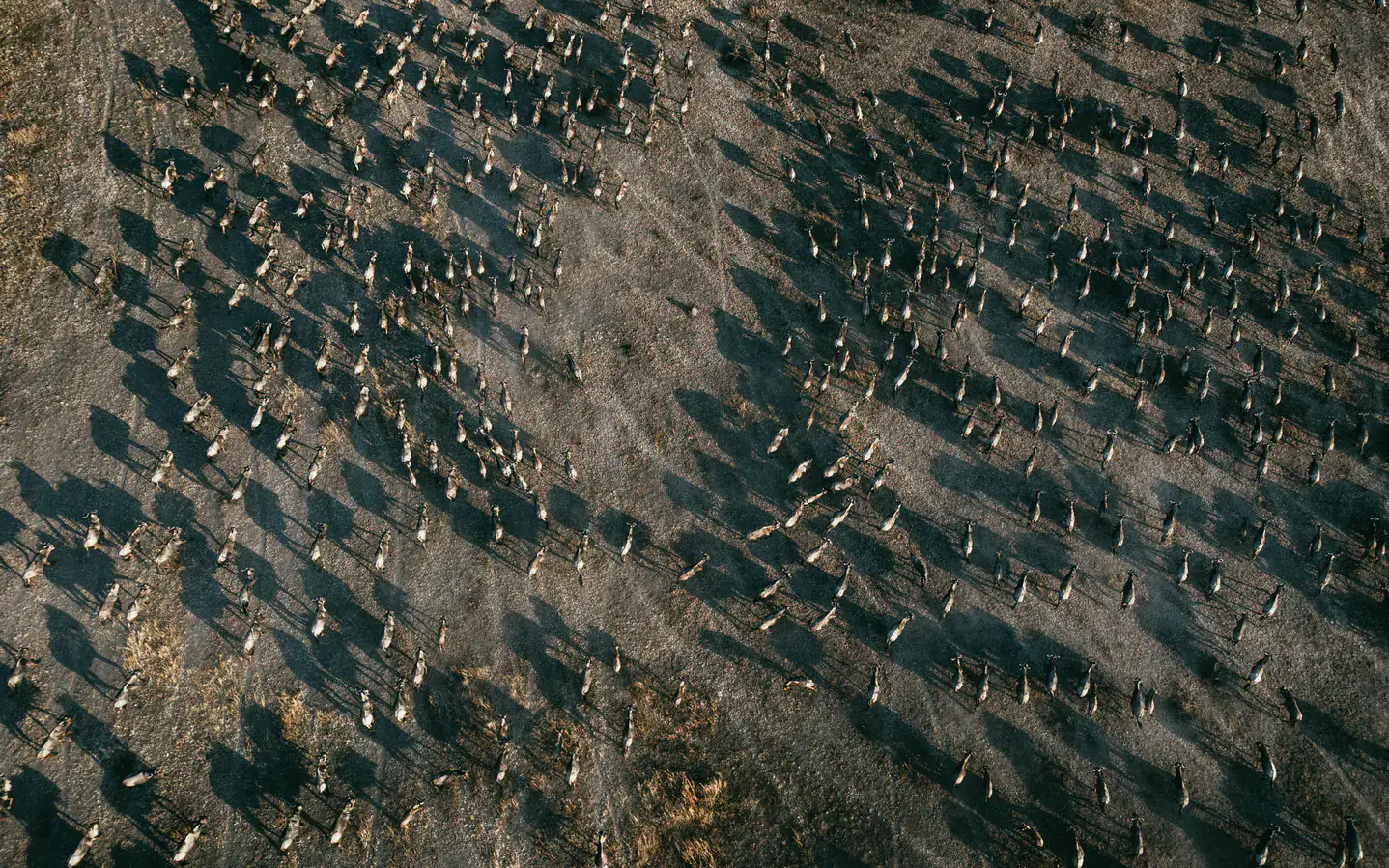
Calving season (Jan–Mar)
Herds mass on the mineral-rich short-grass plains around Ndutu. Around half a million calves are born in a few weeks, and every predator in the ecosystem follows. This is the most intense wildlife viewing of the year.

 English Deutsch
 Français
 Español
 Italiano
 Português
Nearly two million wildebeest and zebra move through the Serengeti ecosystem every year. Here is where they are each month, and how to be in the right place at the right time.
Wildlife Guide
The Great Migration is a continuous year-round cycle, not a single event. Calving happens January to March in the southern Serengeti, the herds move north-west from April to June, and Mara River crossings are most likely from July to September in the northern Serengeti.
Select a month to see where the herds are, what is happening, where to base yourself and how likely a river crossing is.
Herds shuttle back and forth across the Mara River, sometimes several times.
River crossings depend on rainfall and grazing, not the calendar. No operator can guarantee a crossing on a given date.
Planning scores from 1 (low) to 5 (high)
These are planning scores, not guaranteed wildlife outcomes.
For Northern Serengeti migration trips we often recommend flying in or flying out. The region sits far from Arusha, and the saved drive time usually converts into an extra full day at the river.
Herds mass on the mineral-rich short-grass plains around Ndutu. Around half a million calves are born in a few weeks, and every predator in the ecosystem follows. This is the most intense wildlife viewing of the year.
As the plains dry, the herds form long columns heading north-west. May brings the rut, and by June the front-runners reach the Grumeti River where crocodiles wait.
The herds reach the northern Serengeti and cross the Mara River, sometimes back and forth several times. This is the most photographed phase and the busiest.
Short rains green the southern plains and the herds turn back, moving through the central and eastern Serengeti to arrive in the south ready to calve again.
Not sure which phase suits your dates? Send them over and we'll match the region.
| Expectation | Reality | How to plan for it |
|---|---|---|
| A crossing every day | Crossings can be days apart and often happen in minutes | Book three or more nights near the river |
| The herds are always in one place | They spread over enormous distances and move constantly | Use mobile camps that follow the herds |
| Only the north matters | Calving season is arguably the better wildlife spectacle | Consider February as an alternative to August |
| You will be alone at the river | Crossing points attract many vehicles in peak season | Choose camps that allow early departures |
| Any Serengeti camp works | Location within the park is everything | Match camp location to the month, not the brand |
Planning guidance based on typical patterns; nature does not follow a schedule.
More trips are mis-planned around the migration than around anything else in East Africa. Understanding what the herds are actually doing makes the planning decisions obvious.
The Great Migration is the continuous, cyclical movement of roughly 1.5 million wildebeest, accompanied by several hundred thousand zebra and Thomson's gazelle, around the Serengeti–Mara ecosystem. It has no start point and no finish line. The animals move because rainfall creates fresh grazing somewhere else, and they keep moving for their entire lives.
That cycle is broadly predictable in shape and completely unpredictable in detail. The herds will be in the south for calving and in the north for the Mara River in most years, but the exact week they arrive anywhere depends on when and where rain falls. Some years the herds reach the Mara in early July; some years they are still filtering north in August.
The single most valuable planning consequence is this: you cannot book 'the migration'. You book a region on a set of dates, and you choose the region the herds are most likely to be in on those dates.
After the short rains, the volcanic short-grass plains of the southern Serengeti and the Ndutu area of the Ngorongoro Conservation Area produce grazing unusually rich in calcium and phosphorus — exactly what heavily pregnant and lactating wildebeest need. The herds concentrate here, and over roughly three weeks from late January into February several hundred thousand calves are born.
For predators this is the easiest hunting of the year, and for visitors it produces the most concentrated big-cat activity in the Tanzanian calendar. The plains are open with almost no cover, so hunts unfold in full view in a way that simply does not happen in wooded country.
Camps here are often mobile, moving with the herds each season. That is a feature rather than a compromise: a well-positioned mobile camp puts you inside the action rather than an hour's drive from it.
As the long rains arrive and the southern plains dry out, the herds begin drifting north and west into the central Serengeti and then the Western Corridor. Along the way the rut takes place — a chaotic few weeks of males establishing territories, sparring and calling that is genuinely one of the great wildlife spectacles and almost entirely overlooked by visitors.
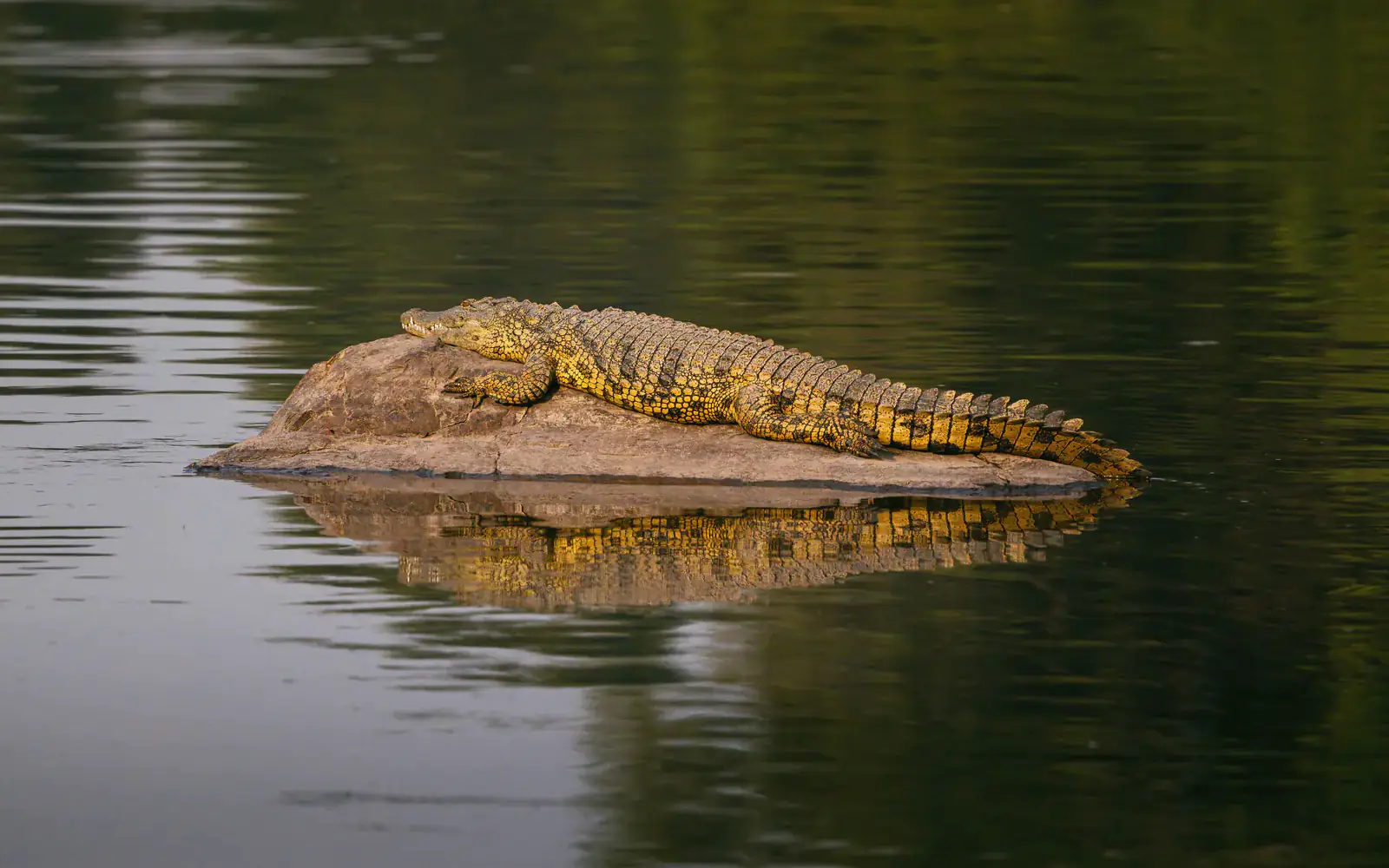
By late May and June the front of the migration reaches the Grumeti River. Grumeti crossings are smaller and less famous than the Mara River events but far less crowded, and the resident crocodiles here are enormous.
This is one of the best-value migration windows in the year: real herd action, genuine crossings, and a fraction of the vehicles you will find at Kogatende in August.
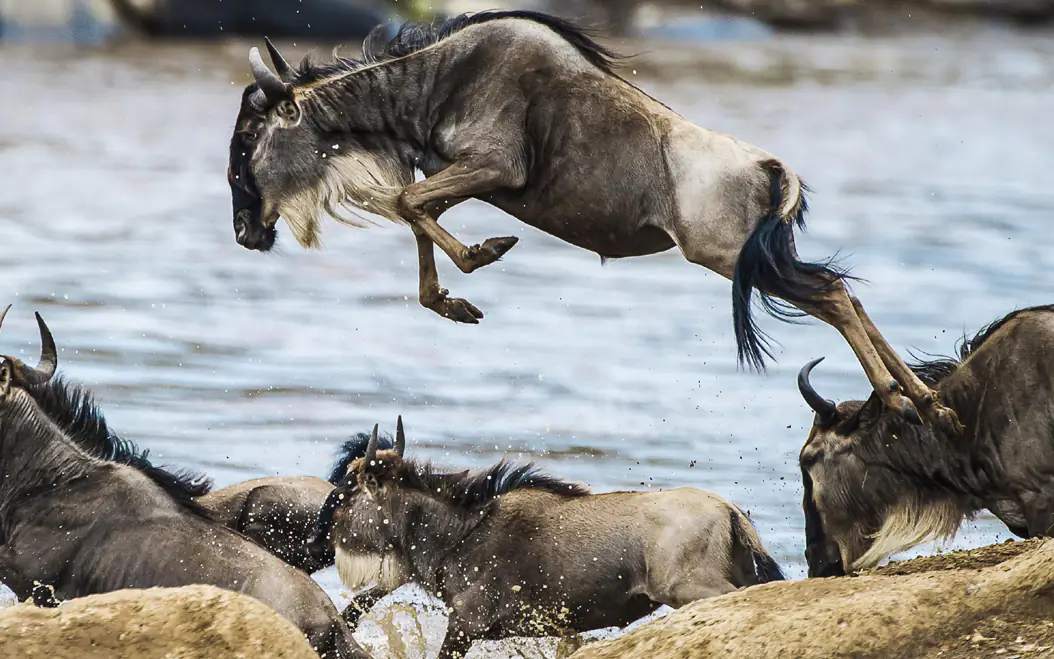
This is the phase most people picture. The herds mass on the southern bank of the Mara River in the far northern Serengeti, hesitate — sometimes for days — and then pour across in the crossings that fill documentaries.
Two honest points. First, crossings are unpredictable: herds gather, turn away, and gather again, and no operator anywhere can promise one on a given date. Second, the classic camps here sell out very early, and the vehicles at a good crossing point in August are numerous.
Our approach is simple: three nights minimum in the far north, a camp within reach of multiple crossing points, and early departures so you are at the river before the crowd builds. With that setup, odds over a three-night stay in peak season are strong — but they are odds, not a guarantee.
As the short rains begin, the herds turn and stream back south through the eastern and central Serengeti toward the plains where the cycle began. Movement in these months can be fast and scattered, which makes precise positioning harder, but it is a quiet and often beautiful time in the park with rates well below the peak.
By late December the front of the herds is usually back on the southern plains, and the calving countdown begins again.
Three practical decisions do most of the work. Choose the region that matches your dates rather than the region you have heard of. Give that region enough nights to absorb bad luck — one night at the Mara River in August is a lottery ticket, three nights is a plan. And pick accommodation by location within the park, not by brand or by photographs.
Beyond that, accept that the herds are wild animals responding to weather. The travellers who come home happiest are the ones who came for the ecosystem — the predators, the plains, the sheer scale of it — and treated a crossing as the bonus it genuinely is.
We track herd position through our guides on the ground and update travellers in the weeks before departure. If the herds shift unexpectedly and your camp is suddenly in the wrong place, that is a conversation worth having early — not on arrival.
The phases described on this page reflect long-term patterns across many seasons. Rainfall drives everything, and rainfall varies. In any given year the herds may arrive in a region weeks earlier or later than usual, and river crossings remain unpredictable even when the herds are standing on the bank.
No operator, ours included, can guarantee a crossing. What we can do is put you in the right region for your dates, with enough nights and the right camp position to give you the best realistic chance.
Send your dates and we'll tell you honestly where the herds are likely to be — and what that means for your route.
Most disappointing safaris come from a handful of avoidable planning decisions.
August in the southern Serengeti misses the herds entirely. Region and month must be chosen together.
Crossings are unpredictable. Build in three nights, not one.
A camp two hours from Kogatende means leaving before the afternoon action starts.
Northern Serengeti camps in August fill roughly a year ahead.
Calving season delivers more predator action than the river months.
A full day each way from Arusha eats two safari days that flying would return to you.
Each phase of the migration has its own region and its own route. These are the three we build most often.
Independent sources you can use to verify park, entry and destination details before you travel.
World Heritage listing and Serengeti ecosystem context
Official Serengeti park information
Independent safari operator reviews
Background ecosystem context
General traveller context for Tanzania
Written and reviewed by the Safari Soles Tanzania planning team, based in Arusha and experienced in building private safari routes across the northern and southern circuits.
Continue with the guides travellers usually read next.
Send your dates, group size and travel style. A local Safari Soles planner replies with a route and a confirmed quote.